Faceless AI videos do not fail because they use automation. They fail when the finished video has no point of view.
A script can be grammatically clean, the voiceover can sound polished, and the visuals can look expensive. But if the episode only repeats a generic summary of information already available everywhere else, viewers feel it quickly. So does YouTube's review logic around original, authentic, and repetitive content.
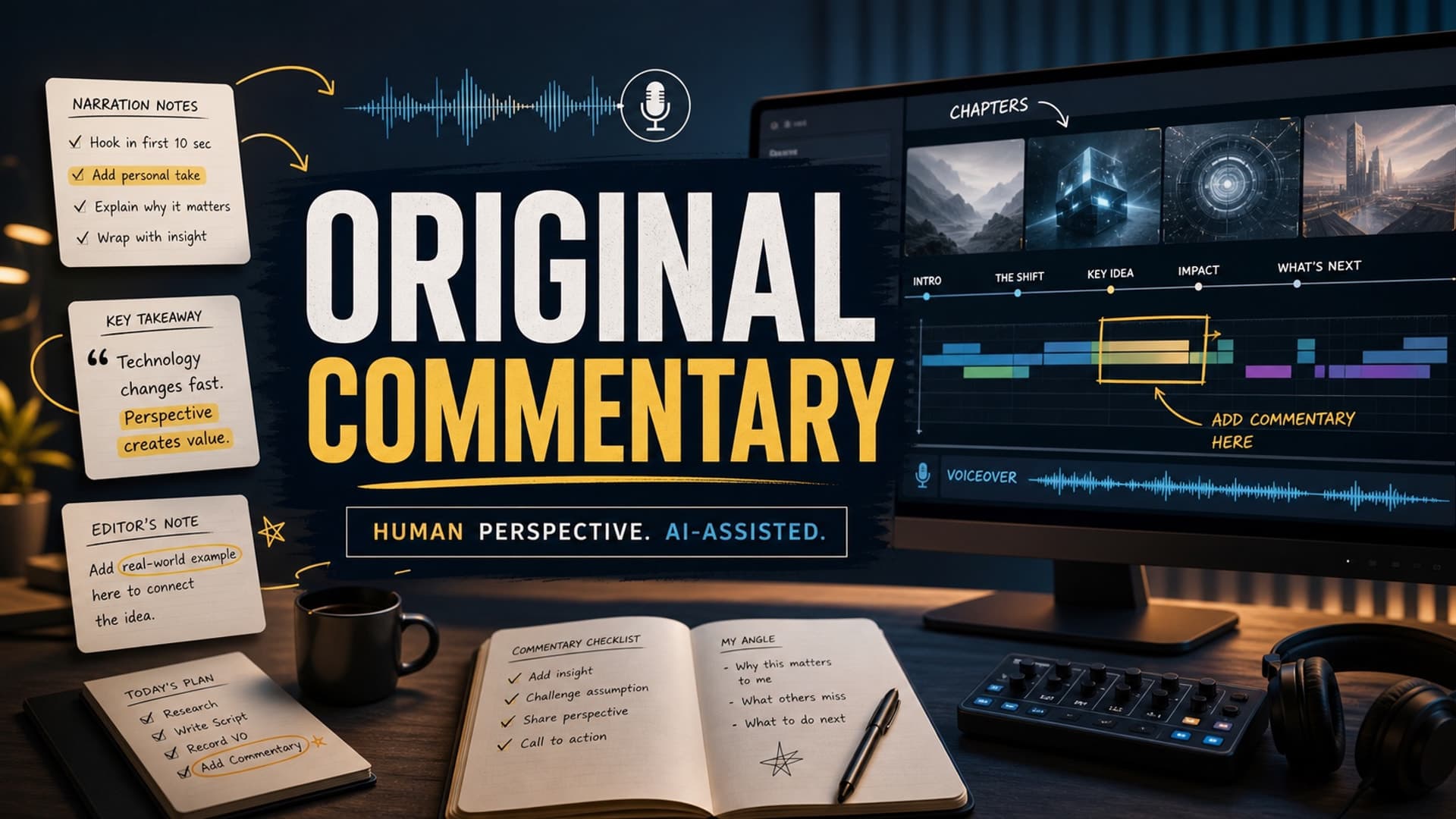
Original commentary is the layer that turns an AI-assisted video from a generated asset into an actual episode. It is where the channel explains what matters, connects dots, challenges easy assumptions, and gives the viewer a reason to stay.
For long-form faceless creators, this is not a nice extra. It is part of the production system.
What Original Commentary Means in a Faceless Video
Original commentary does not mean showing your face, recording a personal vlog, or forcing jokes into a documentary script.
It means the video contains a clear editorial contribution. The viewer should be able to tell what your channel adds beyond collecting facts and arranging them in order.
That contribution can be simple:
- Explaining why a detail matters.
- Comparing two competing interpretations.
- Adding context from adjacent topics.
- Turning a fact into a practical lesson.
- Pointing out what most videos ignore.
- Making a judgment about what is useful, misleading, risky, or surprising.
A faceless science video might explain why a discovery changes the way beginners should understand a topic. A history video might separate the popular myth from the more grounded interpretation. A business documentary might explain the incentive behind a company's decision instead of only listing what happened.
The important part is that the viewer hears a brain at work.
Why This Matters More as AI Video Gets Easier
AI video production keeps lowering the cost of publishing. That is good for serious creators, but it also means YouTube receives more videos that look complete while saying very little.
YouTube's monetization guidance has long separated valuable original work from reused or repetitive uploads. Its altered and synthetic content guidance also pushes creators to be clear when realistic-looking content is materially altered. The pattern is obvious: automation is not the issue by itself. Low-value, misleading, or mass-produced output is the problem.
Original commentary helps on three levels.
First, it improves viewer trust. A long-form video asks for real attention. Viewers are more willing to give that attention when the narration has judgment, not just information.
Second, it improves retention. Commentary creates turns in the episode: "here is the fact," "here is why it matters," "here is the tradeoff," "here is what people get wrong." Those turns keep a 20-60 minute video from becoming a flat list.
Third, it protects the channel from becoming interchangeable. If every creator can generate the same overview from the same prompt, the moat is not access to AI. The moat is the angle.
Build Commentary Into the Script Before Generation
The mistake is trying to add commentary after the video is already written.
By then, the structure is usually too generic. You can sprinkle in a few lines, but the episode still feels like an encyclopedia summary with decoration. Commentary works best when it shapes the script from the outline stage.
A useful script outline should include three fields for each major section:
- What happened or what the viewer needs to know.
- Why this part matters.
- What the channel's angle is.
For example, a section in an AI documentary should not only say, "Explain the launch of the product." It should say, "Explain why the launch changed the market, what competitors misunderstood, and why this moment matters for creators today."
That small difference changes the whole section. The AI writer now has an editorial job, not just a summarization job.
Use Commentary Beats Throughout the Episode
Long-form faceless videos need rhythm. If every paragraph has the same job, the viewer drifts.
A simple way to fix this is to add commentary beats at predictable points:
- Hook beat: what makes this topic worth attention now?
- Context beat: what does the viewer need to understand first?
- Shift beat: what changed?
- Meaning beat: why does that change matter?
- Tension beat: what is the tradeoff or unanswered question?
- Takeaway beat: what should the viewer remember?
These beats are especially useful for documentaries, explainers, AI story channels, and narrated sleep-adjacent educational videos. The tone can still be calm. Commentary does not have to be loud. It just has to be intentional.
For a sleep-style history video, a commentary beat might be soft and reflective: "What makes this detail interesting is not that the system was advanced, but that ordinary people had to adapt to it slowly." For a business explainer, it might be sharper: "The mistake was not building too early. The mistake was assuming distribution would take care of itself."
Make the Commentary Specific, Not Performative
Bad commentary sounds like filler:
"This is very important."
"This changed everything."
"The implications were massive."
Those lines do not add much because they do not tell the viewer what to think about. Strong commentary is specific enough to be useful.
Instead of saying, "This changed everything," explain what changed, for whom, and why it mattered. Instead of saying, "This was controversial," name the tension. Instead of saying, "This is a lesson for creators," state the lesson in plain language.
A good test is whether the commentary line could appear in any video. If it could, rewrite it.
Keep a Commentary Log for Repeatable Quality
If you are producing long-form videos consistently, do not rely on inspiration every time. Keep a simple commentary log for your channel.
Track patterns like:
- Common myths in your niche.
- Recurring mistakes beginners make.
- Opinions your channel tends to defend.
- Questions your audience repeatedly asks.
- Examples that make abstract ideas concrete.
- Comparisons that help viewers understand scale.
This gives your scripts a stronger channel identity over time. It also helps avoid the "same AI voice, same AI structure, same AI conclusion" feeling that makes faceless channels blur together.
The goal is not to make every video personal. The goal is to make every video authored.
How AutoTube.pro Fits Into This Workflow
Once you know the commentary layer you want, AutoTube.pro can help turn it into a repeatable production process.
The platform is built for long-form faceless YouTube creators who need more than a one-off script. You can move from idea to script, AI voiceover, media generation, stock footage, rendering, and thumbnail creation in one workflow instead of passing assets between disconnected tools.
For commentary-heavy videos, the most important step is giving the script system a clear brief: the channel angle, the target viewer, the section structure, and the kinds of insight you want included. From there, the rest of the pipeline can support the editorial plan instead of fighting it.
That matters because original commentary is easiest to preserve when the whole video is built around it. The voiceover pacing, visual choices, chapter flow, and thumbnail promise should all point to the same idea.
FAQ
Does YouTube Penalize AI Voiceover?
YouTube does not automatically penalize a video just because it uses AI voiceover. The bigger issue is whether the video provides original value, follows platform policies, and avoids misleading viewers. A clear script, useful commentary, and honest production choices matter more than the fact that the narration is synthetic.
Is AI-Generated Faceless Content Monetizable?
AI-generated faceless content can be monetizable when it is original, useful, and compliant with YouTube's policies. Channels run into trouble when videos are repetitive, reused, misleading, or mass-produced with little added value. Commentary, structure, research, and quality control all help show that the video is authored rather than merely assembled.
How Much Commentary Should a Long-Form Video Include?
There is no fixed percentage, but every major section should include at least one clear insight, interpretation, or takeaway. If a 30-minute video can be reduced to a generic summary without losing much, it probably needs more commentary. The best amount depends on the niche and pacing.
Can Commentary Work in Calm Sleep-Style Videos?
Yes, but it should match the tone. Calm educational sleep videos can use gentle interpretation, context, and reflective takeaways without becoming intense or distracting. The commentary should make the narration feel thoughtful, not loud.
Should Commentary Be Written Before or After Visuals?
Write the commentary before choosing visuals. Visuals should support the episode's argument and emotional rhythm, not force the script into whatever assets are easiest to generate. This is especially important for long-form videos where weak visual planning compounds over many scenes.
Final Thought
AI can help you produce more videos, but commentary is what helps those videos feel worth watching.
If your current workflow creates scripts, voiceovers, visuals, renders, and thumbnails in separate places, AutoTube.pro gives you one system for building long-form faceless videos around a stronger editorial plan.