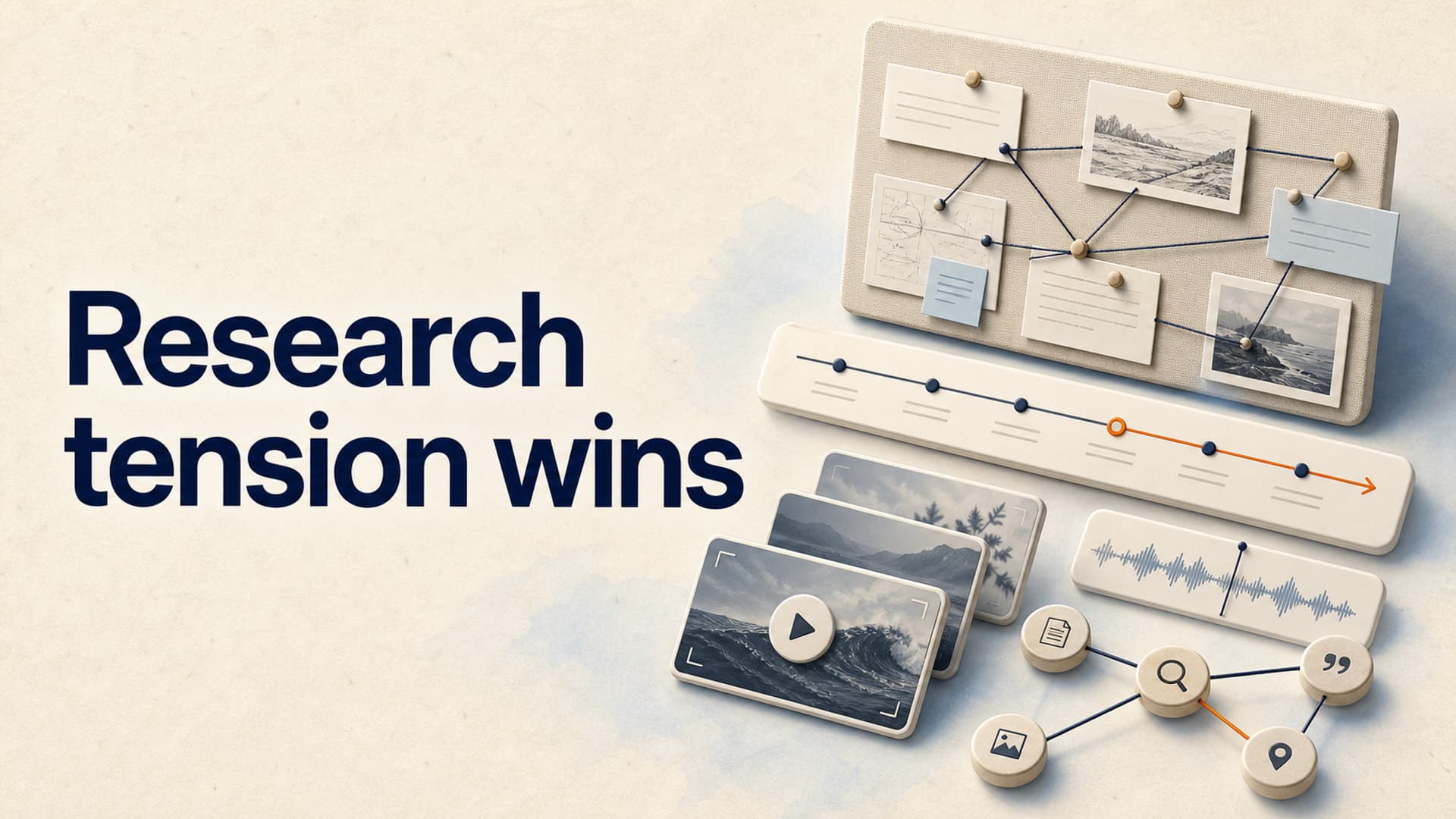
Most weak AI documentaries do not fail because the prompt was too short. They fail because the video has no tension.
The script collects facts. The voiceover reads them cleanly. The visuals look polished enough. But after three minutes, the viewer understands the pattern: one fact, then another fact, then another fact, until the video ends. Nothing is being investigated. Nothing is being challenged. Nothing is being revealed.
That is dangerous for long-form faceless channels because the viewer has to lend you attention without seeing a host. A visible creator can carry some dead air with personality. A faceless documentary has to carry it with structure.
The better question is not, "How do I make AI write a longer script?" It is, "What unanswered question keeps the viewer moving?"
That unanswered question is the research tension.
What Research Tension Means
Research tension is the gap between what the viewer thinks they understand and what the video is going to prove, complicate, or reveal.
It is not clickbait. It is not fake suspense. It is the honest pressure inside a topic.
A weak documentary topic says:
"The history of the Library of Alexandria."
A stronger research-tension version says:
"Why the Library of Alexandria became more powerful as a myth than it may have been as a building."
Both can use the same research base. The second one gives the script a job. It has a claim to test, a misconception to handle, and a reason for the viewer to stay.
For faceless AI channels, this matters more than most creators realize. You can automate drafting, narration, visuals, and editing, but if the topic has no pressure inside it, automation only helps you produce boring videos faster.
The Three-Part Tension Spine
Before writing a long-form documentary script, build a simple tension spine. It has three parts.
1. The Assumption
What does the viewer probably believe before clicking?
For a history video, the assumption might be "ancient people were less technically advanced." For a finance explainer, it might be "the richest person simply made the smartest investment." For a science documentary, it might be "this animal behavior is just instinct."
The assumption is useful because it gives the opening something to push against. Without it, your intro often becomes a bland topic summary.
2. The Complication
What makes the assumption incomplete?
This is where research starts doing real work. Maybe the historical record is disputed. Maybe the simple explanation ignores geography, incentives, timing, or a forgotten character. Maybe the most repeated online version of the story leaves out the part that actually explains the outcome.
The complication is where many AI scripts go thin. They list the obvious facts because the prompt asks for a documentary about a topic. A better brief asks for the conflict inside the research.
3. The Payoff
What should the viewer understand differently by the end?
The payoff does not need to be a shocking twist. It can be a clearer mental model.
For a 45-minute faceless documentary, the payoff might be: "The empire did not collapse because of one dramatic failure. It became too expensive to keep pretending the old system still worked."
That kind of payoff gives the script direction. Every section can either set up, pressure, or resolve the idea.
A Worked Example
Take a generic AI documentary idea:
"The strange history of sleep in medieval Europe."
That could become a decent video, but it has no built-in engine yet. It invites the script to wander through beds, candles, monks, medicine, and folklore.
Now add a tension spine:
Assumption: People in the past slept badly because their lives were primitive.
Complication: Many pre-industrial sleep patterns were adapted to darkness, labor, religion, and household rhythms rather than simply being failed versions of modern sleep.
Payoff: The history of sleep is not a straight line toward comfort. It shows how technology changed what people considered normal rest.
Now the video has shape.
The intro can open with the modern assumption. The first act can show how darkness organized the night. The second act can examine segmented sleep, communal rooms, religious schedules, and fear. The third act can contrast that with artificial light, clocks, factories, and the modern bedroom. The conclusion can make the viewer feel that "normal sleep" is more historically fragile than they assumed.
That is much stronger than asking an AI tool for "a 45-minute script about medieval sleep."
Why This Helps With Originality
YouTube's monetization guidance keeps returning to the same underlying standard: original, authentic value. The platform's current policy language does not say that AI production is automatically the problem. It warns against repetitive, mass-produced, low-variation content that gives little educational, narrative, commentary, or creator perspective.
A research tension spine helps because it forces every video to have a specific intellectual reason to exist.
Two channels can cover the same topic. The one with a stronger angle will feel more original because it is not merely summarizing the public internet. It is organizing the material around a point of view.
That point of view can be calm, neutral, and documentary-style. It does not have to be loud. But it should be present.
For faceless creators, this is also a practical defense against sameness. If your scripts all use the same opening rhythm, the same section pattern, and the same "here are five facts" structure, the channel begins to feel templated even when each topic is technically different.
How to Brief AI Without Flattening the Story
A common mistake is asking for the finished script too early.
A better workflow is:
- Ask for research leads and source categories.
- Ask for competing explanations or controversies.
- Ask for the viewer's likely assumption.
- Ask for three possible tension spines.
- Choose one spine before drafting the outline.
- Draft the script section by section against that spine.
This adds a few minutes up front, but it prevents a much more expensive failure later: a long video that sounds complete but has no reason to be watched.
Here is a practical prompt frame:
"I am making a long-form faceless documentary about [topic]. Give me three possible research-tension spines. For each one, define the viewer assumption, the complication, the final payoff, the kinds of sources needed, and what would make the angle feel generic or misleading."
That last clause matters. Asking what would make the angle generic or misleading is a pressure test. It makes the AI look for the failure mode before you spend time drafting.
Use Realistic AI Carefully
AI visuals can make documentary ideas feel more cinematic, especially when the subject is historical, speculative, dangerous, microscopic, extinct, or otherwise hard to film. Recent AI film projects show how synthetic imagery can depict events or scenes that would be impossible to capture directly.
But realism changes viewer expectations.
YouTube has made AI labels more visible for photorealistic or meaningfully altered/generated content, and it has also started applying labels automatically when significant photorealistic AI use is detected. YouTube says the label by itself does not change recommendation or monetization eligibility, but the viewer still experiences it as a trust signal.
So the question is not only "Can I generate this scene?" It is also "Does this scene make the story clearer without pretending to be archival proof?"
A good rule for AI documentaries: use realistic synthetic visuals to illustrate, not to counterfeit evidence. If a scene is interpretive, make the narration honest about uncertainty. If a claim depends on a real source, let the script carry the evidence instead of asking the image to imply certainty.
Where AutoTube.pro Helps
This is where AutoTube.pro is useful for long-form faceless documentary channels: it helps turn a stronger research angle into repeatable production without forcing every step through a different tool.
The most relevant capability here is research-backed script generation. Instead of starting from a single raw prompt, creators can build long-form scripts from real web research and structured outlines, which fits documentary, explainer, and story formats. That matters when the goal is not just to make a video, but to preserve the tension spine from idea to outline to narration.
The channel presets also help. If a documentary channel has a consistent voice, pacing, visual style, and description format, those defaults can be reused across videos while the actual research angle changes each time. That is the useful version of consistency: stable presentation, varied substance.
And when the script is ready, the timed-visual workflow reduces the manual drag of matching media to narration. For long-form creators, that means more energy can stay on the angle, evidence, and structure instead of disappearing into asset hunting and timeline syncing.
Start With the Pressure Point
Before producing your next AI documentary, write one sentence:
"The viewer thinks this is about [obvious topic], but it is really about [deeper pressure]."
If that sentence is weak, do not start generating scenes yet. Improve the angle first.
Long-form faceless channels are not rewarded just for having more content. They are rewarded when viewers feel each video gives them a reason to stay, a reason to trust it, and a reason to watch the next one.
Better prompts help. Better visuals help. But the research tension is what gives the documentary a spine.