A viewer types a very specific question: "Why did Roman concrete survive seawater when modern concrete cracks?" They are not necessarily looking for a channel, a familiar creator, or even a ten-word title match. They want the most useful explanation YouTube can find.
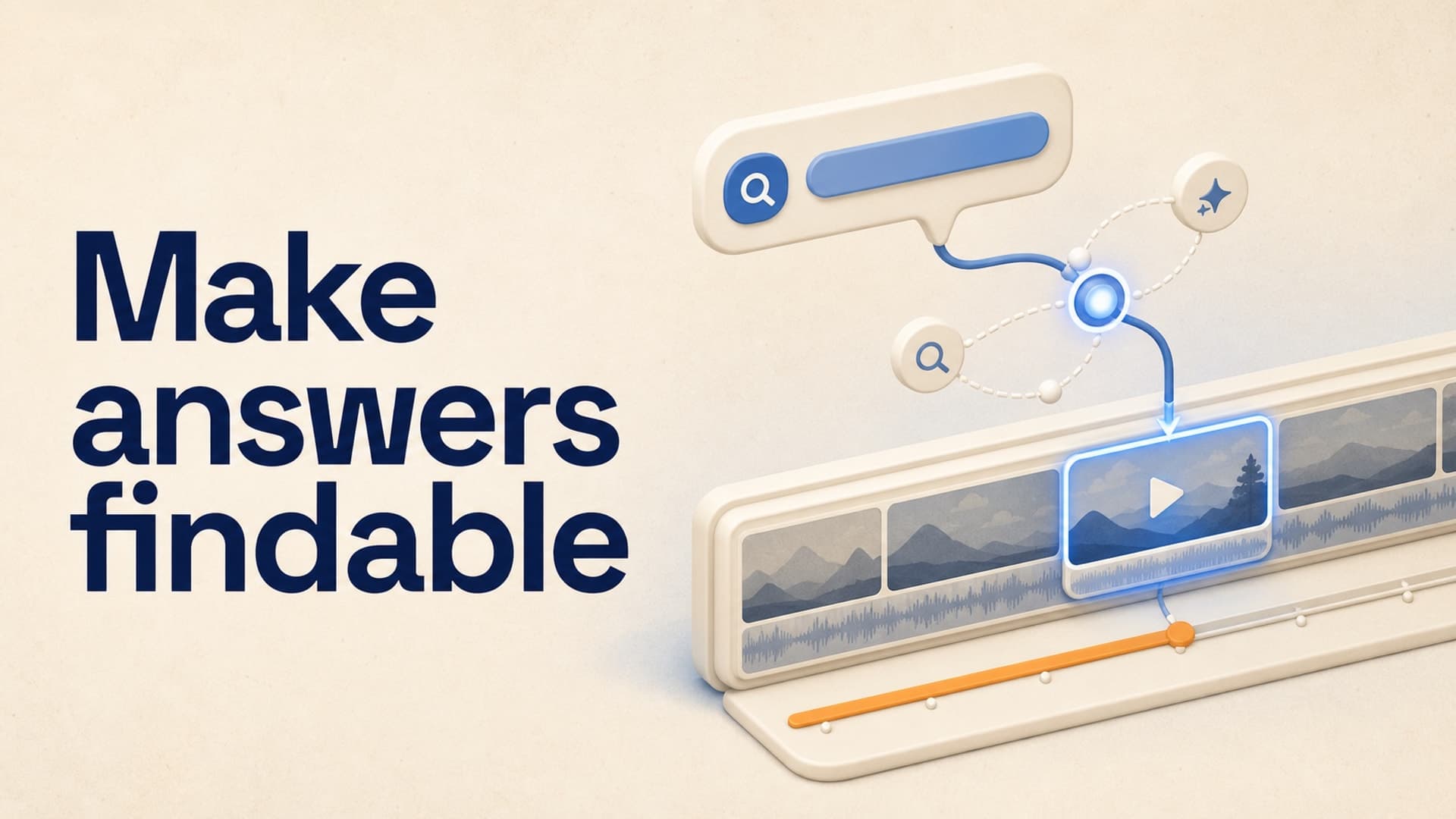
That matters because YouTube is experimenting with a conversational search experience called Ask YouTube. Instead of returning only a familiar list of videos, it can combine text with relevant videos and clips, then let the viewer refine the question. YouTube describes it as an additional path for creators to be discovered.
This is not proof of a new ranking formula, and creators should resist anyone selling one. The experiment is still limited, and YouTube has not published an optimization checklist. But the product direction is clear enough to justify a practical test: make the best answer moments inside a long-form video easier for both people and systems to recognize.
The useful unit is no longer just the video. It may also be the 45-120 seconds in which the video answers one precise question unusually well.
Search Now Has a Clip-Level Destination
Traditional YouTube search encouraged creators to think in packages: topic, title, thumbnail, description, and the opening promise. Those still matter. Ask YouTube adds another possible destination - a relevant passage within the video.
That changes the job of an outline. A good long-form outline has always needed narrative momentum. Now it can also contain self-sufficient answer moments that make sense when a viewer lands near the middle.
Consider a 28-minute faceless documentary about Roman concrete. A viewer might arrive with any of these questions:
- What made Roman marine concrete different?
- Did volcanic ash cause the durability?
- Can modern builders copy the formula?
- Why does seawater help one material and damage another?
A title cannot carry all four intents without becoming unreadable. A well-structured script can. Each question can live at a natural point in the story, receive a direct answer, and then pull the viewer into the next piece of the explanation.
The goal is not to chop a documentary into disconnected FAQ entries. It is to build a coherent story with clear retrieval points.
Replace the Keyword List With a Question Ladder
Before outlining, write one primary question and three supporting questions. Each supporting question should do a different job:
- Mechanism: How does it work?
- Boundary: When does the explanation stop being true?
- Consequence: Why does the answer matter?
For the Roman concrete example, the ladder might look like this:
- Primary: Why did Roman marine concrete survive for so long?
- Mechanism: What reaction occurs between seawater, volcanic material, and lime?
- Boundary: Was every Roman structure made with the same durable mix?
- Consequence: Why is reproducing the material harder than copying an ancient recipe?
This is stronger than a list of near-synonymous keywords because every question creates a distinct editorial obligation. The mechanism needs an explanation. The boundary needs nuance. The consequence needs a payoff.
It also protects the script from generic AI expansion. If a section cannot answer one rung of the ladder, advance the central argument, or set up the next reveal, it probably does not deserve two minutes of narration.
Give Each Important Answer a Recognizable Shape
An answer block is a short passage that resolves one question without sounding like a search result was pasted into the script. A useful block usually takes 45-120 seconds and follows five beats:
- Orient: Name the question in natural language.
- Answer: Give the direct answer in one or two sentences.
- Explain: Show the mechanism, evidence, or causal chain.
- Qualify: Add the exception that prevents the answer from becoming misleading.
- Bridge: Explain why the next section follows.
Here is the difference in miniature.
Weak version: "Roman concrete was durable because of its ingredients. It was an amazing invention used in many structures."
Stronger version: "Seawater did not merely fail to destroy some Roman harbor concrete. It helped new minerals form inside it. The volcanic material and lime created a chemistry that could fill small cracks over time - but that does not mean every Roman wall was self-healing or that one universal recipe existed. To understand why modern copies remain difficult, we have to look at how uneven the original materials were."
The stronger passage is useful in context and still understandable if someone enters at that point. It states the answer, explains it, limits it, and opens a loop.
Do not force this shape onto every paragraph. Use it for the three or four questions with real discovery value. The rest of the script should still create atmosphere, suspense, contrast, and pacing.
Run a Timestamped Findability Audit
After the script is drafted, review it as if you were landing from an unfamiliar query. Create a small audit table before producing the voiceover:
| Timestamp | Viewer question | Direct answer starts | Works out of context? | Fix |
|---|---|---|---|---|
| 03:10 | What made the concrete durable? | 03:24 | Mostly | Name the material before saying "it" |
| 09:40 | Did seawater help? | 10:18 | No | Move the answer ahead of the laboratory detail |
| 17:05 | Can we copy it today? | 17:12 | Yes | Keep |
Three checks catch most problems:
- Pronoun check: Search for openings built around "this," "that," or "it." Replace the first vague reference with the actual subject.
- Answer-lag check: If the direct answer arrives more than about 30 seconds after the question is introduced, decide whether the suspense earns the wait.
- Context check: Read only the 30 seconds before and after the answer. Add one sentence of orientation if the passage depends on information from much earlier.
This audit is not about gaming an AI system. It improves the experience for anyone who scrubs, resumes after a break, follows a chapter link, or arrives at a relevant clip.
Avoid the Fake Optimization Traps
New discovery surfaces always attract rituals that look measurable but weaken the video. Four are especially risky:
- Repeating the same question word-for-word throughout the narration.
- Stuffing chapter names with awkward query variants.
- Front-loading every answer until the story has no tension.
- Making confident claims merely because certainty sounds easier to extract.
YouTube's existing recommendation guidance still emphasizes viewer response and satisfying content, not metadata tricks. Tags are not essential for discovery, and a mechanically optimized script that viewers abandon has missed the larger job.
Treat answer clarity as an editorial layer, not a substitute for narrative. The video still needs a compelling promise, credible research, clean pacing, and a reason to continue after the first answer lands.
Turn the Answer Map Into Production
For creators working across separate research, writing, narration, and editing tools, the easiest place to lose the question ladder is during handoffs. An outline becomes a generic script, the direct answer moves during revision, and production starts before anyone checks whether the key passages still work alone.
AutoTube.pro is one practical way to keep that work connected. Its research-backed long-form script generation starts from real web research and structured outlines, which makes it suitable for carrying a primary question and supporting ladder into a documentary or explainer draft. Because creators can run the workflow step by step, they can stop after the script stage, perform the timestamped findability audit, and revise weak answer blocks before committing to later production.
That boundary matters more than adding another optimization feature. The most expensive time to discover a vague answer is after narration and visual timing are finished. The cheapest time is while the passage is still text.
Use the platform as the production layer, not as permission to skip editorial judgment. You still decide which questions deserve answers, where uncertainty belongs, and whether the story remains worth watching from beginning to end.
Make One Video Easier to Retrieve This Week
Choose one planned long-form video and write its four-question ladder before drafting. Mark the three passages most likely to answer a specific viewer query, then run the timestamped audit while revisions are still cheap.
Do not rebuild your entire channel around an experiment. Run the test, watch how viewers find and navigate the video, and keep the parts that make the story clearer even if Ask YouTube changes. If you want that script review to live inside a connected long-form production process, explore the workflow.