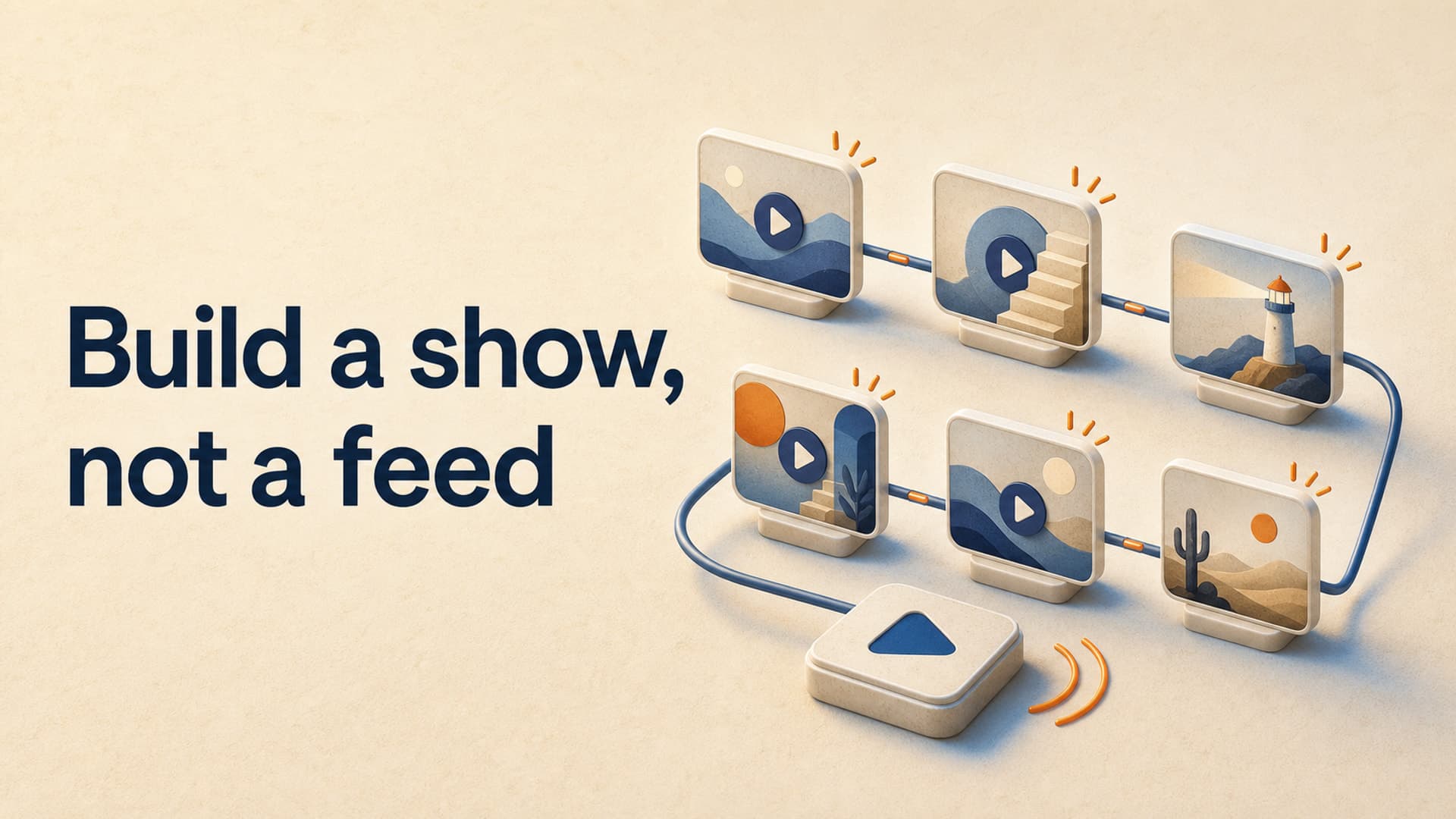
A faceless channel can publish consistently and still feel impossible to follow.
The problem is not always quality. It is often that every upload starts from zero: a new premise, a new visual language, a new research burden, and a new reason for the viewer to care. One video may perform, but it does not naturally create demand for the next one.
A show works differently. It gives viewers a recognizable promise and gives the creator a repeatable production frame. The individual episodes still need strong ideas, but they no longer have to introduce the entire channel from scratch.
That matters more now because YouTube is giving episodic viewing more structure. The platform has described seasons and shows as a way to make creator content easier to discover and binge-watch on larger screens. Official series playlists can also help YouTube understand that a group of videos belongs together. The opportunity is not to imitate television budgets. It is to borrow television's clearest advantage: the next episode already makes sense before it exists.
A Series Is a Promise, Not a Playlist
Putting six unrelated videos in a playlist does not create a series. A useful series has one sentence that explains why the same viewer would want every episode.
Try this formula:
Each episode helps [specific viewer] experience or understand [repeatable subject] through [recognizable format].
For example:
Each episode helps curious history viewers understand how a seemingly impossible city survived through one engineering decision.
That sentence creates boundaries. A biography of a famous architect might be interesting, but it does not belong unless it serves the promise. A video about a city's water system probably does. The constraint is useful because it stops the channel from wandering whenever a random topic looks clickable.
A strong season promise passes three tests:
- It has range. You can name at least six genuinely different episodes without padding.
- It has recognition. A returning viewer can identify the format from the title and thumbnail before seeing the channel name.
- It has escalation. Later episodes can deepen, challenge, or pay off ideas introduced earlier.
If the idea only supports two good videos, make it a pair. Do not stretch a theme into a season because “series” sounds strategic.
Map Six Episodes Before Producing One
Six episodes is a useful planning unit. It is long enough to reveal whether the premise has depth, but short enough that a weak concept does not consume a quarter of your year.
Use this six-part shape:
- The doorway: the most accessible version of the premise.
- The mechanism: the episode that explains how the underlying system works.
- The surprise: a case that contradicts the obvious assumption.
- The pressure test: the system facing a failure, crisis, or extreme condition.
- The consequence: the human, financial, or cultural cost.
- The payoff: the episode that answers the season's largest question.
For a faceless documentary season called “Cities That Should Not Work,” the rough map might look like this:
| Role | Working episode |
|---|---|
| Doorway | How Venice Learned to Float |
| Mechanism | The Water System Hidden Under a Desert City |
| Surprise | Why a Sinking City Keeps Growing |
| Pressure test | What Happens When a Capital Runs Out of Water |
| Consequence | The Neighborhoods Sacrificed to Save a Coast |
| Payoff | Can a City Outbuild the Rising Sea? |
These are not finished titles. They are editorial jobs. Separating the job from the packaging prevents a common mistake: choosing six clickable phrases that all deliver the same episode.
Before production, write three lines under every slot:
- the question the episode will answer;
- the evidence or story that makes it distinct;
- the idea that points naturally to another episode.
If two slots rely on the same evidence and reach the same conclusion, merge or replace one now. Discovering duplication in a season map costs minutes. Discovering it after two 45-minute renders costs days.
Create Handoffs Without Hiding the Best Episode
Series often fail because creators package them like mandatory homework. “Episode 4” is meaningful to the producer and meaningless to a new viewer.
Let every video work as an entry point. Put the strongest standalone promise in the title. Keep season and episode labels in the description, playlist, or a restrained thumbnail system instead of leading with them.
Then create a deliberate handoff in the final 25-40 seconds:
- resolve the question the viewer clicked for;
- introduce one adjacent question that remains open;
- name the specific next video that answers it;
- leave visual space for that video's end-screen element.
A weak ending says, “Watch another video on the channel.” A strong ending says, “Venice solved weight from below, but the next city survives by moving water above ground. That system is here.”
The second version gives the click a reason. It also forces the production team to decide the next-view path while scripting, not after the render is finished.
YouTube's own recommendation guidance encourages creators to use series, clear calls to action, playlists, and end screens to help viewers find more of their work. That does not guarantee recommendations. It does make the viewer journey less dependent on luck.
Reuse the Frame, Vary the Substance
A repeatable show should reduce setup work without making the videos feel mass-produced.
Keep four elements stable:
- the opening question arrives within the same rough window;
- narration follows a familiar tone and pace;
- evidence appears through a consistent visual grammar;
- the ending performs a specific next-episode handoff.
Vary at least two:
- the type of central conflict;
- the source mix;
- the chapter rhythm;
- the balance of archival, stock, map, diagram, and generated imagery;
- the emotional temperature of the conclusion.
Think of this as a format envelope. The stable elements make the channel recognizable. The variable elements prove that each episode was made for its subject.
For production, turn the envelope into a one-page season card:
- viewer promise;
- six episode roles;
- intro rule;
- narration direction;
- visual rules;
- minimum evidence standard;
- ending handoff rule;
- thumbnail constants and variables.
The card should be specific enough that a collaborator can spot drift, but short enough to consult during a real deadline.
Judge the Season as a Portfolio
Do not declare the concept dead because episode one misses your usual view count. A new series has to teach both viewers and the creator what it is.
Review the six episodes on two levels.
At the episode level, compare:
- click response to each topic and package;
- average view duration and the largest early exit;
- end-screen click rate to the named next episode;
- comments that ask for a related case.
At the season level, ask:
- Which episode became the strongest entry point?
- Did viewers move to another episode in the same series?
- Which production rules saved time without lowering quality?
- Did the sixth episode feel like a payoff or merely another upload?
- Can the premise support a second season with a different organizing question?
Use a 2-by-2 decision after the run:
| Audience response | Production repeatability | Decision |
|---|---|---|
| Strong | Strong | Renew the season |
| Strong | Weak | Simplify the format |
| Weak | Strong | Repackage or narrow the promise |
| Weak | Weak | End the series and keep the lessons |
This keeps one outlier from making the decision for you. A viral episode inside an exhausting format is not automatically a scalable show. A cheap format nobody wants is not a business either.
A Faster Way to Keep the Show Consistent
The operational risk appears after the season map is approved. Re-entering the same style instructions, voice choices, and visual direction for every episode invites small differences that accumulate into channel drift.
AutoTube.pro is one practical way to reduce that reset work for long-form faceless production. Reusable channel presets keep the voice, script style, visual direction, media choices, and render defaults attached to the channel rather than scattered across separate tools.
For a documentary or explainer show, its research-backed script generation can turn each episode brief into a structured long-form draft while preserving the season's shared direction. You can run production as one connected workflow when the format is stable, or stop between stages to revise an episode that needs more editorial care.
The useful distinction is that the season plan remains the creative authority. Automation handles repeated execution; it should not decide why episode four exists or what makes it different from episode three.
Plan the Return Before the Premiere
Take the next six ideas on your channel and stop treating them as six independent bets. Write one viewer promise, assign each idea an editorial role, and design the handoff between them.
If the promise becomes clearer as the map fills, you may have a show. If every idea fights the frame, you have learned that before spending weeks producing it. Either result is useful.