Most faceless YouTube creators do not fail because they lack prompts.
They fail because every video starts from zero.
One upload has a serious documentary tone. The next sounds like a listicle. The third uses a different pacing style, a different visual rhythm, a different narrator personality, and a thumbnail promise that belongs to another channel. Nothing is technically broken, but the channel never becomes recognizable.
The tempting fix is to collect more prompts: script prompts, hook prompts, thumbnail prompts, voice prompts, visual prompts, title prompts. That can help for a week. Then the same problem returns because prompts are instructions for one task. A channel needs a repeatable format.
That is where a format bible matters.
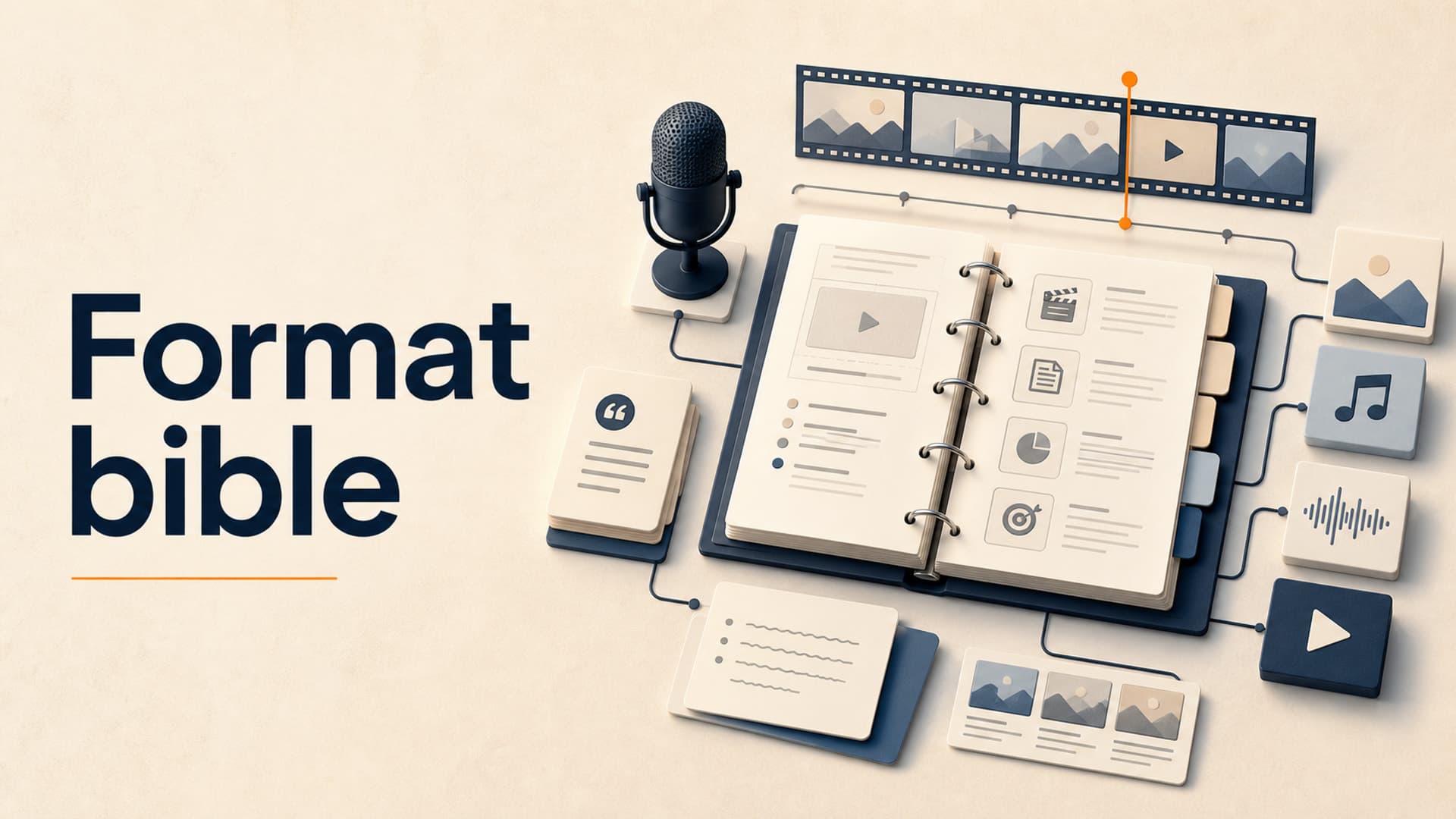
A format bible is a short operating document that defines how your channel makes videos: what each episode promises, how the script moves, what the narrator sounds like, what visual language belongs to the channel, and where each video is allowed to vary. It gives you consistency without making the videos feel copied.
That distinction is becoming more important. YouTube's monetization policy explicitly draws a line between repeatable formats with materially different substance and mass-produced, repetitive content with minimal variation. A good format bible helps you stay on the right side of that line because it standardizes the container, not the substance.
The Prompt Library Trap
A prompt library looks productive because it gives you reusable text. The hidden problem is that prompts usually preserve surface instructions, not editorial judgment.
A typical script prompt says something like: write a 45-minute faceless documentary in a calm tone with a strong hook, clear sections, and a satisfying conclusion. That is fine as a starting point, but it does not define what your channel believes a strong hook is. It does not say how fast the video should reveal its premise, whether the narrator should be skeptical or cozy, how much evidence belongs in each act, or what type of ending makes viewers want the next episode.
So each prompt run improvises the channel again.
A format bible answers the questions that should not be re-decided every time:
- What kind of viewer is this episode serving?
- What emotional state should the viewer be in by minute 3?
- What does the channel never do, even when a trend would make it easy?
- How much variation is required between episodes?
- Which parts of the format are fixed, and which parts are episode-specific?
For a long-form faceless channel, this is more valuable than a larger prompt vault. Long videos need trust. Viewers may spend 30, 60, or 120 minutes with a narrator they cannot see. If the channel's format changes wildly between uploads, the audience has to relearn the experience every time.
What a Format Bible Should Actually Contain
Keep it short. If the document becomes a 40-page brand manual, nobody will use it during production.
A practical format bible for a faceless YouTube channel can fit into six sections.
1. The Channel Promise
Write the promise in one sentence.
Not a niche. Not a slogan. A promise.
Weak: "AI history documentaries."
Better: "Calm, deeply researched history stories that help viewers unwind while still learning something real."
Weak: "Faceless finance explainers."
Better: "Plain-English money stories that make complicated financial events feel understandable without hype."
This sentence becomes a filter. If an idea does not serve the promise, it is not just a weak topic. It is off-format.
2. The Episode Shape
Define the recurring structure of a typical video.
For example, a 45-minute documentary might use:
- 0:00-1:30: quiet open with the central mystery or contradiction
- 1:30-5:00: context the viewer needs before the story begins
- 5:00-20:00: first escalation, built around people, places, or causes
- 20:00-35:00: deeper complication or reversal
- 35:00-42:00: resolution, consequence, or modern connection
- 42:00-45:00: soft landing, recap, and next-video bridge
The exact numbers can change, but the shape gives every script a spine. It also prevents the most common long-form failure mode: spending too long on setup, then rushing the strongest material near the end.
For sleep channels, the shape might be slower and less dramatic. For explainers, it might be tighter and more argument-driven. For AI story channels, it may revolve around acts, character turns, and recurring world rules.
The point is not to make every episode identical. The point is to stop every episode from becoming structurally random.
3. Voice and Narration Rules
A faceless channel's voice is not only the audio model. It is the editorial personality.
Define the narrator in operational terms:
- Sentence length: short, medium, or winding?
- Energy: calm, urgent, curious, skeptical, warm, eerie?
- Vocabulary: simple and direct, academic, cinematic, conversational?
- Point of view: neutral guide, investigator, storyteller, analyst?
- Prohibited moves: fake cliffhangers, exaggerated claims, cheap fear, forced jokes?
A useful test: paste two paragraphs from different episodes side by side. If the same channel could not plausibly have published both, the voice rules are too loose.
For long-form AI production, this matters because small voice drift becomes large over an hour. A slightly more dramatic sentence style can make the voiceover feel rushed. A slightly denser script can make visuals feel late. A slightly more sensational hook can attract the wrong viewer for the next 50 minutes.
4. Visual Language
Do not define visuals as "high quality" or "cinematic." Those words are too vague to guide production.
Define the visual language in concrete choices:
- Primary visual types: archival-style images, maps, abstract diagrams, animated panels, stock footage, generated scenes, or simple illustrated scenes.
- Camera feel: still, slow push, lateral movement, documentary montage, or mostly static sleep-friendly framing.
- Color range: muted earth tones, dark museum palette, clean editorial, warm parchment, or cold technical.
- Reuse rules: what can repeat across episodes, and what must be made fresh?
- Realism boundary: when realistic AI scenes require disclosure or should be avoided.
The realism boundary is worth writing down. YouTube asks creators to disclose AI-generated or meaningfully altered content when it appears realistic, including realistic scenes that did not actually occur. If your channel uses AI visuals, your format bible should say which visual styles are intended to be clearly illustrative and which could look like documentary evidence.
That one line can prevent messy decisions at upload time.
5. Variation Requirements
Consistency is good. Sameness is dangerous.
Write rules that force each episode to bring new value. For example:
- Every episode needs at least three topic-specific details that could not be reused in another script.
- Every documentary needs one original framing question, not just a rewritten title.
- Every explainer needs one concrete example, calculation, or comparison.
- Every story episode needs a new conflict pattern or character pressure.
- Every video needs a visual motif that belongs only to that episode.
This is the part many creators skip. They document the repeatable pieces but not the required variation. That is how a format becomes a template.
A healthy format bible should make production faster while forcing substance to stay fresh.
6. The Pre-Publish Check
End the format bible with a short review gate.
Before publishing, ask:
- Does this video clearly belong to the channel?
- Does it contain enough episode-specific substance?
- Does the script follow the intended pacing arc?
- Does the narration match the channel voice?
- Do the visuals support the format without pretending to be evidence?
- Would a returning viewer feel continuity, not repetition?
This check is not bureaucracy. It is how a one-person channel starts behaving like a small studio.
A Worked Example: Turning a Loose Niche Into a Format
Take a loose niche: "AI documentaries about strange historical events."
That is not a format yet. It is a topic area.
A format bible might sharpen it like this:
Channel promise: "Slow, evidence-led stories about strange historical events, told without conspiracy bait or jump-scare pacing."
Episode shape:
- Open with the strange claim, but do not answer it immediately.
- Spend the first 10% establishing what normal looked like before the event.
- Move through 3-4 causes, witnesses, documents, or interpretations.
- Reserve one section for what people commonly get wrong.
- End with the most honest explanation, including uncertainty where needed.
Voice rules:
- Calm narrator.
- No phrases like "you won't believe" or "what happened next shocked everyone."
- Use short topic-setting sentences at section transitions.
- Avoid moralizing unless the source material clearly supports it.
Visual rules:
- Use maps, archival-style stills, location imagery, slow zooms, and restrained generated illustrations.
- Avoid photorealistic scenes that could be mistaken for actual footage unless disclosure is planned.
- Use one recurring visual device: a simple evidence board or timeline marker at each major turn.
Variation rules:
- Each episode must include one primary source or documented artifact.
- Each episode must have one unique visual motif tied to the event.
- No two consecutive uploads should use the same story shape, such as disappearance, scandal, disaster, or hoax.
Now the channel has a production system. A prompt can still help write, summarize, or storyboard, but it is no longer carrying the entire identity of the channel.
Where a Format Bible Changes Production
The value shows up before the script is written.
Topic selection becomes easier because you can reject ideas that do not fit the promise. Scripting becomes cleaner because the episode shape is already defined. Voiceover becomes more consistent because the narrator has rules beyond "sound natural." Visual production becomes less chaotic because the team knows what belongs on screen. Review becomes faster because the question is not "do I like this?" but "does this match the format and add enough new substance?"
This is especially useful for creators making long videos. A 12-minute mistake is annoying. A 90-minute mistake can consume days of scripting, narration, visual generation, editing, and rendering before you realize the episode never felt like the channel.
A format bible moves that decision earlier.
Doing This Without the Tool Sprawl
A format bible is useful even if you build everything manually. But it becomes much more powerful when your production system can reuse the format instead of making you paste the same instructions into five disconnected tools.
AutoTube.pro is built around that idea for long-form faceless channels. You can configure reusable channel defaults for script style, voice, visual style, media, rendering, and descriptions, then use those defaults across new videos instead of rebuilding the setup every time.
For a format-bible workflow, the most relevant pieces are the channel presets and research-backed script generation. The presets help preserve the parts of the format that should stay stable. The script workflow helps each episode start from real research and structure, so the output has a better chance of being materially different rather than just a templated rewrite.
You can still edit between stages when an episode needs judgment. The point is not to remove the creator from the process. It is to stop wasting creator attention on re-stating the format every time a new video enters production.
Start With One Page
Do not wait until the channel is big enough to "deserve" a format bible. Write the first version before your next upload.
One page is enough:
- One sentence for the channel promise.
- One episode structure.
- Five voice rules.
- Five visual rules.
- Three variation requirements.
- One pre-publish checklist.
Then improve it after each video. If a rule helped, keep it. If a rule made the episode worse, rewrite it. If a video performed well for a reason you can repeat, add that reason to the bible.
A prompt library helps you operate faster. A format bible helps your channel become recognizable.
For long-form faceless YouTube, that recognition is the asset.