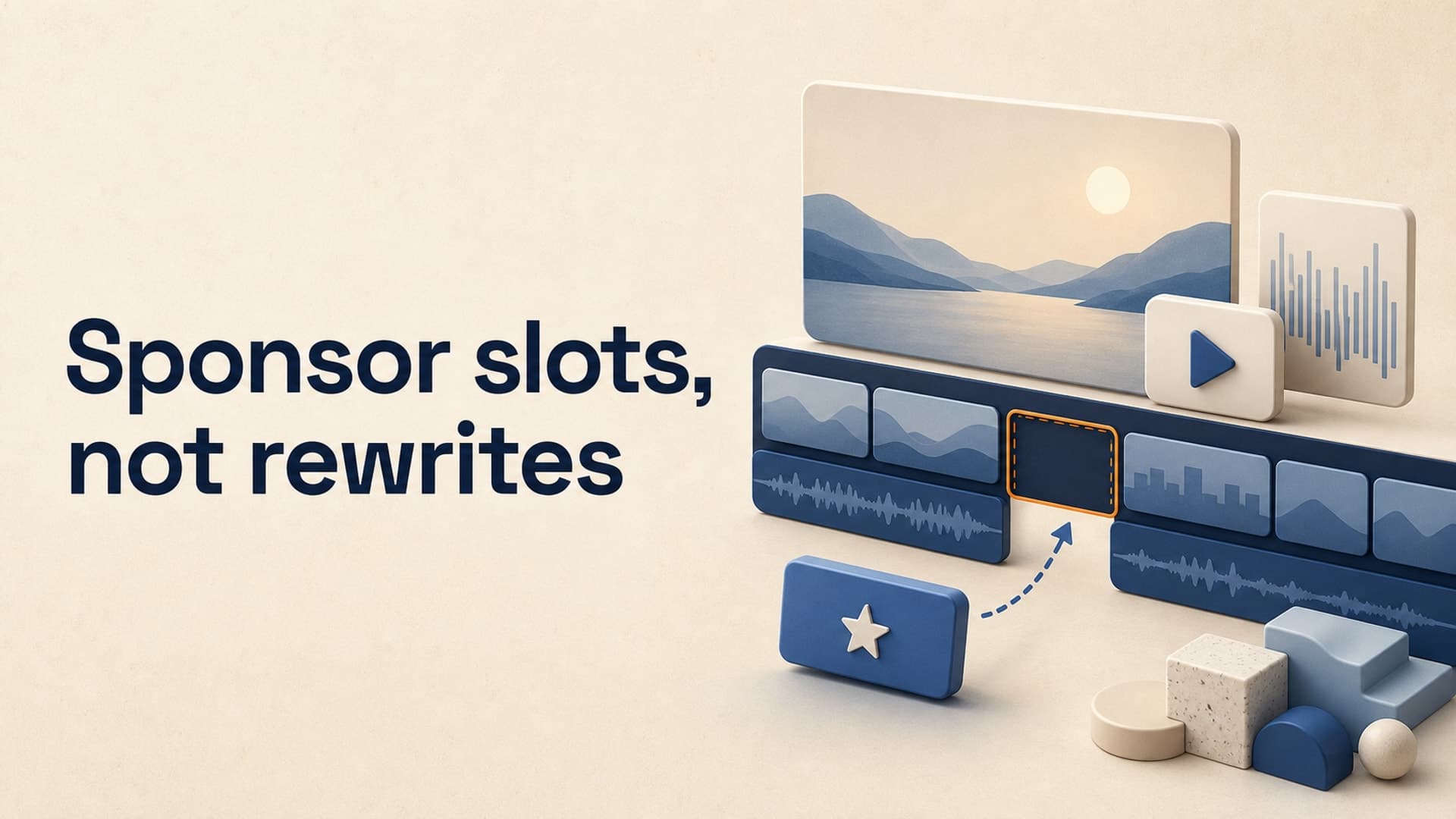
A sponsor read can look like a small interruption in a finished video. In production, it behaves more like a dependency: change the brand, offer, deadline, or legal language and suddenly the narration, captions, visuals, music, and edit all need another pass.
That is expensive in any video. It is especially painful in a 20-minute documentary or a two-hour narrated sleep video.
YouTube has already signaled where this is heading. The platform announced that it would test swappable sponsorship slots in long-form videos, instead of forcing every brand segment to remain permanently burned into the original upload. The feature is not a universal creator tool yet, but the production lesson is useful now: a faceless channel should stop treating a sponsor read as inseparable from the episode.
The better approach is to design a replaceable sponsor slot before the script is written.
Separate the Episode From the Campaign
Most sponsor problems begin because three different things are mixed together:
- The episode is the lasting viewer promise: the documentary, story, explainer, or sleep narration.
- The slot is a planned break with a clean entry and exit.
- The campaign is the temporary brand message placed inside that slot.
Only the campaign should expire.
If the sponsor copy contains facts that the next chapter depends on, replacing it will damage the story. If the presenter says, “As our sponsor just showed us,” the campaign has leaked into the episode. If a branded music cue continues under the next section, the audio is no longer modular.
A good test is simple: remove the entire sponsor segment and play the ten seconds before and after it. The story should still make sense. The transition may need a short neutral bridge, but the viewer should not lose a fact, premise, or emotional beat.
Design Two Clean Seams
A replaceable slot needs an entrance seam and an exit seam.
The entrance seam closes the previous editorial thought before the paid message begins. The exit seam restarts attention without pretending the interruption never happened. Both should be written into the master script, not improvised after the voiceover is rendered.
For example:
Editorial close: “That was the theory. The shipwreck evidence tells a different story.”
Neutral bridge into slot: “Before we examine the wreck, a quick word from today’s sponsor.”
Sponsor campaign: Brand-specific copy, proof, offer, and disclosure.
Neutral bridge out: “Now, back to the evidence on the seabed.”
Editorial restart: “The first clue is the timber itself.”
The first and last editorial lines remain in the episode master. The neutral bridges can remain fixed or be included in each sponsor asset. The campaign in the middle can change.
Do not place the slot halfway through a sentence, explanation, list, or suspense reveal. Those positions may create short-term attention, but they make replacement fragile and can make the interruption feel more aggressive than the message deserves.
A Worked 22-Minute Sponsor Slot
Consider a 22-minute faceless history documentary with four chapters. The creator wants room for a 60-second sponsor read without rebuilding the episode for every campaign.
A practical slot might look like this:
| Element | Target duration | Purpose |
|---|---|---|
| Entry bridge | 4-6 seconds | Clearly closes editorial content and introduces the break |
| Problem and relevance | 10-15 seconds | Connects the product to a real viewer need |
| Product value | 25-30 seconds | Explains what the sponsor does in plain language |
| Proof or demonstration | 8-12 seconds | Shows one credible reason to believe the claim |
| Offer and action | 8-12 seconds | States the offer, URL, or next step |
| Exit bridge | 4-6 seconds | Returns to the exact editorial question in progress |
That gives the campaign a working range of roughly 55-75 seconds. The range matters more than a single exact length. A 58-second replacement should not force the editor to stretch a logo animation to fill a 75-second hole.
Place this slot after a completed chapter, around minute 7 or 8, rather than at a fixed percentage of the runtime. In this example, chapter one establishes the mystery and chapter two explains the leading theory. The sponsor appears after the theory closes. Chapter three then begins with the physical evidence.
The slot is therefore attached to a narrative boundary, not a timestamp that only works in one edit.
Make a Sponsor Asset Packet, Not One Render
The deliverable should be more than a single exported clip. Keep a small campaign packet for each sponsor version:
- Approved script with required claims and pronunciation notes.
- Clean voiceover file with no music baked in.
- Caption file or timed transcript for only the sponsor segment.
- Visual assets with documented usage rights and campaign dates.
- Music and sound effects on separate stems.
- Final segment export at the same resolution, frame rate, loudness target, and color treatment as the episode.
- Written disclosure and placement requirements supplied by the brand.
The separate stems are important. If the campaign changes but the music is embedded in the voice track, a simple copy revision becomes a complete audio rebuild. Likewise, if captions are burned into an intermediate asset and the offer changes, the visual cannot be reused safely.
Treat the sponsor packet as versioned production material. A filename such as episode-014_sponsor_acme_v3_approved is boring, which is exactly what you want when a brand requests a last-minute wording change.
Keep the Read Native Without Making It Permanent
Modular does not have to mean generic. The sponsor should still sound as though it belongs in the episode.
Borrow the channel’s established narration pace, sentence length, visual grammar, and level of humor. A calm sleep-history channel should not suddenly become a high-energy commercial. A documentary channel should not make a claim with more certainty than it uses in the editorial narration.
The trick is to personalize the surface while keeping the structure independent. You can reference the audience’s problem or the channel’s format. Avoid referencing a fact that exists only in the surrounding chapter, because that makes the campaign harder to move or reuse.
Also distinguish a creator-read sponsorship from an advertiser-supplied commercial. YouTube’s paid-promotion guidance allows creator integrations but does not simply permit creators to burn conventional third-party ad spots into videos. The brand, creator, and format need to fit the platform’s rules, and the creator is still responsible for the required paid-promotion declaration and any local legal obligations.
Failure Modes to Catch Before Export
Run a five-point replacement check before publishing:
- Story check: Does the episode remain coherent when the campaign is removed?
- Audio check: Do the loudness, room tone, voice, and music transition cleanly at both seams?
- Visual check: Does the first post-sponsor frame clearly return the viewer to the episode?
- Caption check: Can sponsor captions change without touching editorial captions?
- Rights check: Are the campaign’s claims, assets, usage window, and disclosure instructions recorded?
The most common failure is the exit. Creators often spend all their effort making the ad read persuasive, then return with a vague “anyway.” That forces a viewer who mentally stepped away to reconstruct the story.
Write the re-entry as a miniature second intro: one sentence that restores the question, location, person, or conflict. It should be specific enough to reorient the viewer but short enough not to repeat the entire previous chapter.
Producing Sponsor-Ready Scripts With Less Rework
AutoTube.pro can support this kind of modular production because long-form scripts are created from research and structured outlines, rather than one unbroken prompt. That makes it easier to plan a sponsor boundary between complete sections instead of slicing through a paragraph after narration exists.
The step-by-step workflow is the most relevant option here. A creator can generate the script, review the sponsor seam, and make the campaign-specific edit before moving on to voiceover and timed visuals. Saved channel presets also help keep narration and visual treatment consistent when a campaign segment is produced alongside the episode.
The goal is not to automate the sponsor relationship. Approval, claims, disclosures, and brand instructions still need human review. The useful part is preventing a temporary campaign from destabilizing the permanent episode.
Frequently Asked Questions
Where should a sponsor segment go in a long-form YouTube video?
Place it after a complete editorial beat, not at an arbitrary percentage of the runtime. A chapter boundary usually gives you cleaner transitions and makes the story easier to resume.
How long should a YouTube sponsor read be?
There is no universal length. For many creator-read integrations, a working window of about 55-75 seconds gives enough room for relevance, value, proof, and a clear action without turning the segment into a second video. The contract and message should determine the final duration.
Do sponsored YouTube videos need a disclosure?
Yes, creators need to notify YouTube when a video contains paid promotion, and other disclosure duties may apply based on location and campaign. The platform’s checkbox does not necessarily replace clear language inside the video or description, so follow the agreement and applicable rules.
Can a sponsor send a finished commercial to insert into the video?
Do not assume that a conventional advertiser-supplied commercial can simply be burned into creator content. YouTube distinguishes permitted paid promotions from third-party ad formats, so review the current platform policy before accepting the asset.
Will a sponsor break hurt audience retention?
Any interruption can lose viewers, but the effect depends on timing, relevance, length, and re-entry. Use a completed narrative beat, keep the message honest, and restore context immediately after the segment rather than hiding the break inside an unfinished thought.
Build the Empty Slot Before You Sell It
You do not need an active brand deal to make the next video sponsor-ready. Add one clean boundary to the script, export a version with no campaign, and test whether the episode still flows when the slot is empty.
That small production decision turns a sponsor edit from emergency surgery into a controlled replacement. It also gives a potential partner something more useful than a vague promise: a defined place in the episode, a duration range, and a repeatable approval workflow.