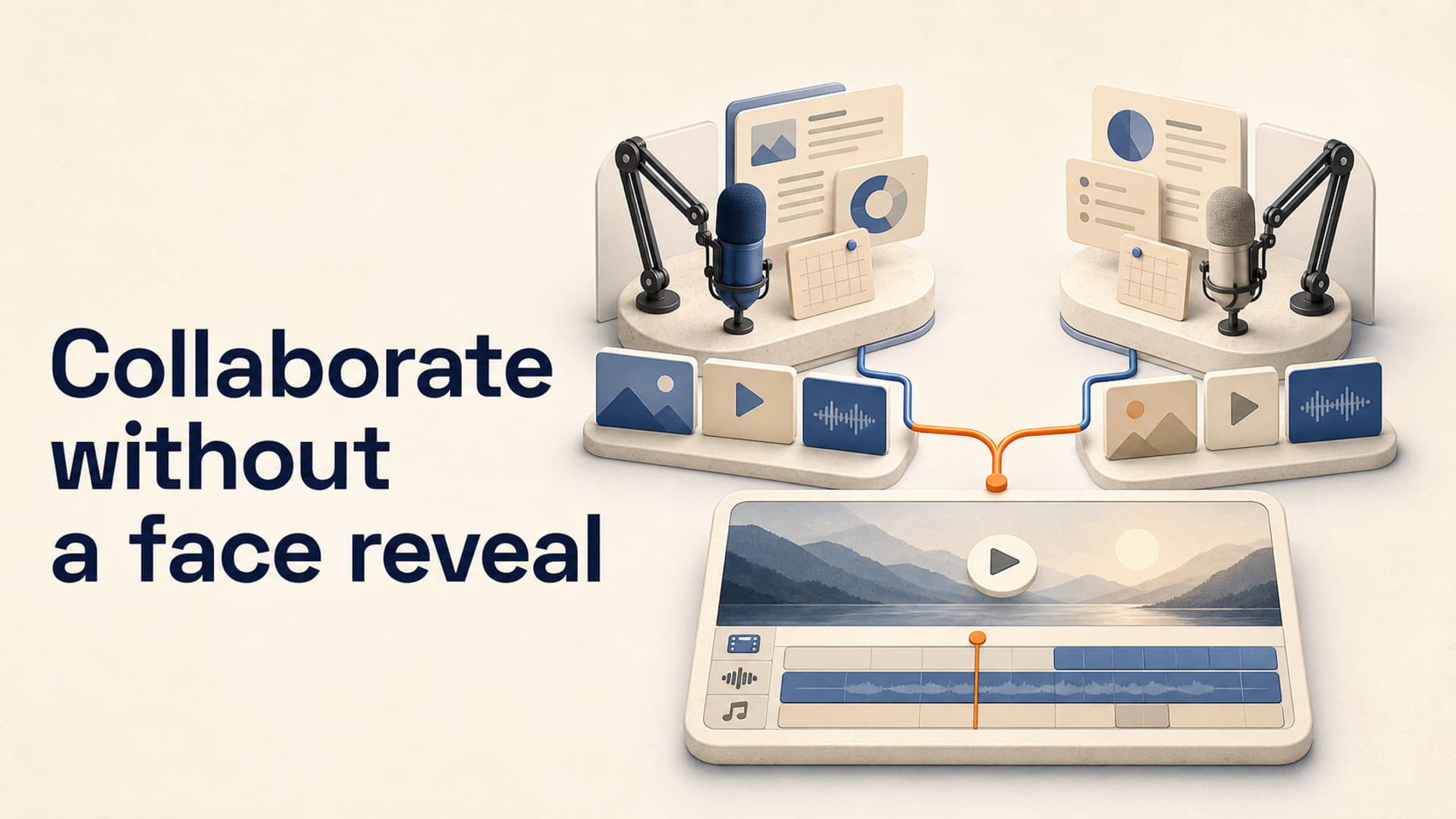
Two creators agree to collaborate. Then the obvious question appears: who goes on camera?
For a faceless channel, that question is usually a distraction. A useful collaboration does not require a shared studio, a split-screen conversation, or a sudden face reveal. It requires two channels to contribute something the other could not make as convincingly alone.
YouTube's collaboration feature now makes that partnership visible on the video itself. An accepted collaborator's channel name and subscribe button can appear to viewers on desktop, mobile, and TV. YouTube says the feature is intended to help discovery across the participating audiences, although it does not promise an immediate recommendation lift.
That creates a real opportunity for long-form faceless creators - and a new set of production decisions. The best collaboration is not the one with the most names attached. It is the one where the audience can hear, see, or understand each creator's contribution.
A Collaboration Is Not the Same as a Guest Appearance
A guest appearance adds a person. A collaboration combines editorial assets.
For a faceless documentary channel, those assets might be original research, access to an archive, a distinctive narration style, subject expertise, a recurring fictional character, or a visual treatment. None requires either creator to appear on screen.
Start by completing this sentence:
This video is better with both channels because Channel A contributes ___ and Channel B contributes ___.
If both blanks say "promotion," the concept is not ready. Audience exchange can be a benefit, but it cannot carry a 20-minute video. The collaboration needs a creative reason that remains valuable to someone who has never heard of either channel.
YouTube currently allows collaborators on long-form videos, and the help page says up to 10 creators can be invited. That is a technical ceiling, not an editorial target. Two clear roles are easier for viewers to understand than a crowded list of channels with token contributions.
Four Formats That Work Without a Face Reveal
The collaboration format should determine the production plan. These four structures give each channel a visible job while preserving a faceless identity.
The paired investigation
Both creators investigate the same question from different evidence sets. A history channel might examine official records while an archaeology channel interprets physical evidence. The finished video alternates between proof blocks and resolves disagreements in the conclusion.
This works when the sources genuinely produce different perspectives. It fails when two creators merely summarize the same search results.
The narrator handoff
One channel hosts the video while a second narrator takes over a clearly defined chapter, document, character, or counterargument. The handoff is introduced in the script so the voice change feels intentional.
Use this sparingly. Switching narrators every minute creates cognitive friction, especially in sleep-oriented or audio-first videos. One substantial guest section is usually stronger than a dozen short interjections.
The expert challenge
The host builds a thesis, then the collaborator stress-tests it. An economics explainer could propose why an industry collapsed; a second creator could challenge the claim with labor data or a competing interpretation.
The disagreement must be real but bounded. Write the disputed question before production and agree on what evidence could change the conclusion. Manufactured conflict damages trust faster than it creates retention.
The shared-world episode
Story and animation channels can exchange a character, location, artifact, or event while keeping separate narratives. Each video should stand alone, with the connection acting as a reward rather than required homework.
This format needs a rights note covering who owns the shared element and whether either creator can reuse it later. A friendly idea exchange can become a messy ownership dispute once one episode performs well.
Write the Deal Before You Write the Script
YouTube's collaboration label does not divide production responsibility or revenue for you. Its help documentation states that the channel where the video is posted receives the earned revenue; YouTube does not split it among collaborators.
That makes the host channel the first decision, not an administrative detail. Put a one-page agreement in writing with these seven fields:
| Field | Decision to record |
|---|---|
| Host channel | Where the finished video will be published |
| Viewer promise | The single question or outcome in the title and opening |
| Contributions | Research, writing, narration, visuals, review, and promotion owners |
| Money | Flat fee, revenue share handled outside YouTube, reciprocal contribution, or no payment |
| Rights | Who owns raw files, voices, characters, research, and the finished edit |
| Approval | Who can request changes and who has final editorial control |
| Failure plan | What happens if a deadline slips or the video is never published |
Do not use "we will split it fairly" as the money field. Define the calculation, reporting source, payment schedule, refund treatment, and duration if revenue will be shared privately. If the value exchange is reciprocal instead - one hosted video for each channel - record what counts as an equivalent deliverable.
The same clarity applies to promotion. "Share it with your audience" could mean a community post, a mention in another video, an email, or nothing measurable. Name the action and date without pretending either creator controls the result.
A Worked 18-Minute Handoff
Imagine a faceless history channel and a logistics explainer collaborating on a video about how a besieged city kept eating.
The host owns the story structure and final edit. The collaborator supplies one 600-word proof block on transport capacity, reviews every numerical claim, and records a 90-second narrated challenge to the host's opening assumption.
The production map could look like this:
- 0:00-2:00 - The impossible promise. The host establishes the siege, population, and apparent supply problem.
- 2:00-6:00 - The normal system. The host explains markets, storage, and routes before the siege.
- 6:00-9:00 - The logistics challenge. The collaborator's narration and evidence show why the obvious supply estimate is wrong.
- 9:00-14:00 - Three adaptations. The host tests rationing, substitution, and smuggling against that constraint.
- 14:00-17:00 - The breaking point. Both evidence sets converge on what finally failed.
- 17:00-18:00 - The answer. The host resolves the opening question and identifies the remaining uncertainty.
This is a genuine collaboration because removing either contribution weakens the argument. It is also reviewable. The collaborator does not need access to every project file; they need the outline, their source requirements, the narration specification, and the exact review window.
Set three delivery gates: evidence accepted, script section locked, and final-context approved. Do not ask the collaborator to discover a factual problem after the full video has rendered.
Make the Handoff Feel Like One Video
Viewers should notice a useful change in perspective, not a collision between two production systems.
Create a compact handoff packet before either person records or generates assets:
- Pronunciation notes for names, places, and technical terms
- Target narration pace and emotional range
- File format and loudness expectations for contributed audio
- Aspect ratio, framing, and visual exclusions for supplied media
- Citation format and the minimum evidence required for factual claims
- Two reference minutes from the host channel that demonstrate the intended rhythm
Then run a continuity pass focused on transitions. Introduce the collaborator before the voice or visual language changes. After their section, restate the new fact in the host's framing and show how it changes the argument.
Avoid flattening both creators into identical output. The point is coordinated contrast. Preserve the collaborator's distinctive insight while keeping typography, audio level, pacing, and source standards consistent enough that the viewer never has to re-learn how to watch the video.
Judge the Collaboration as a Controlled Test
Do not call the partnership successful because both creators enjoyed making it, or unsuccessful because it did not instantly become the channel's biggest upload.
Before publishing, choose one comparable solo video from the host channel and record its first 7-day and 28-day results. Compare the collaboration on:
- Click-through rate, to see whether the combined promise improved packaging
- Retention at the collaborator introduction and handoff
- New versus returning viewers
- Subscribers gained per 1,000 views
- Comment quality, especially mentions of the second contribution
The most diagnostic moment is the handoff. If retention drops precisely when the collaborator enters, inspect whether the introduction was too long, the audio changed sharply, or the guest section paused the story. If viewers quote or debate the collaborator's evidence, the second perspective probably earned its place even if total views are ordinary.
Use the 28-day result to decide among three next steps: repeat the format, revise the handoff, or end the experiment. One upload is evidence about a format - not a permanent merger between two channels.
A Cleaner Way to Coordinate the Production
A faceless collaboration becomes fragile when each contributor is working from a different prompt, voice setup, and visual reference folder. AutoTube.pro is one practical way for the host to keep the production side coherent without erasing the collaborator's contribution.
Saved channel presets can preserve the host's established voice and visual style across the episode. Research-backed script generation can turn the agreed viewer promise, evidence blocks, and counterargument into a structured long-form outline instead of blending both creators' notes into one loose prompt.
The stage-by-stage workflow matters most here. The host can review and edit the script before generating narration, then review again before committing to visuals and the final render. Those checkpoints line up naturally with the three delivery gates: accept the evidence, lock the collaborator's section, and approve it in context.
The platform does not negotiate rights, split collaboration revenue, or replace the one-page agreement. It reduces production drift after the editorial deal is clear.
Common Questions About Faceless Collaborations
Can two faceless YouTube channels collaborate without revealing their identities?
Yes. They can exchange research, narration, characters, visuals, or expert review without appearing on camera or sharing personal details. Only disclose the information needed to deliver and credit the work safely.
Does YouTube split collaboration revenue automatically?
No. YouTube says the channel where the collaboration video is posted receives the earned revenue. Any fee or revenue-sharing arrangement between creators needs a separate written agreement and payment process.
Will adding a collaborator guarantee more recommendations?
No. YouTube says collaborations are intended to encourage discovery and may be recommended to participating audiences, but creators may not notice changes immediately. The video still needs a strong standalone promise and satisfying execution.
Who should own the finished collaboration video?
The agreement should name the owner before production begins. It should also distinguish ownership of the finished edit from underlying research, narration recordings, characters, music, and reusable source files.
Make One Contribution Impossible to Remove
Choose a potential partner and do not start by pitching an audience swap. Pitch a video where their research, voice, world, or expertise changes the answer.
Write the one-page agreement. Build one meaningful handoff. Measure what happens at that exact moment. If the contribution could be deleted without weakening the video, redesign the collaboration before you produce it.
If you want to keep the host channel's long-form production consistent while adding a collaborator's evidence and perspective, AutoTube.pro can give that experiment a repeatable place to run.