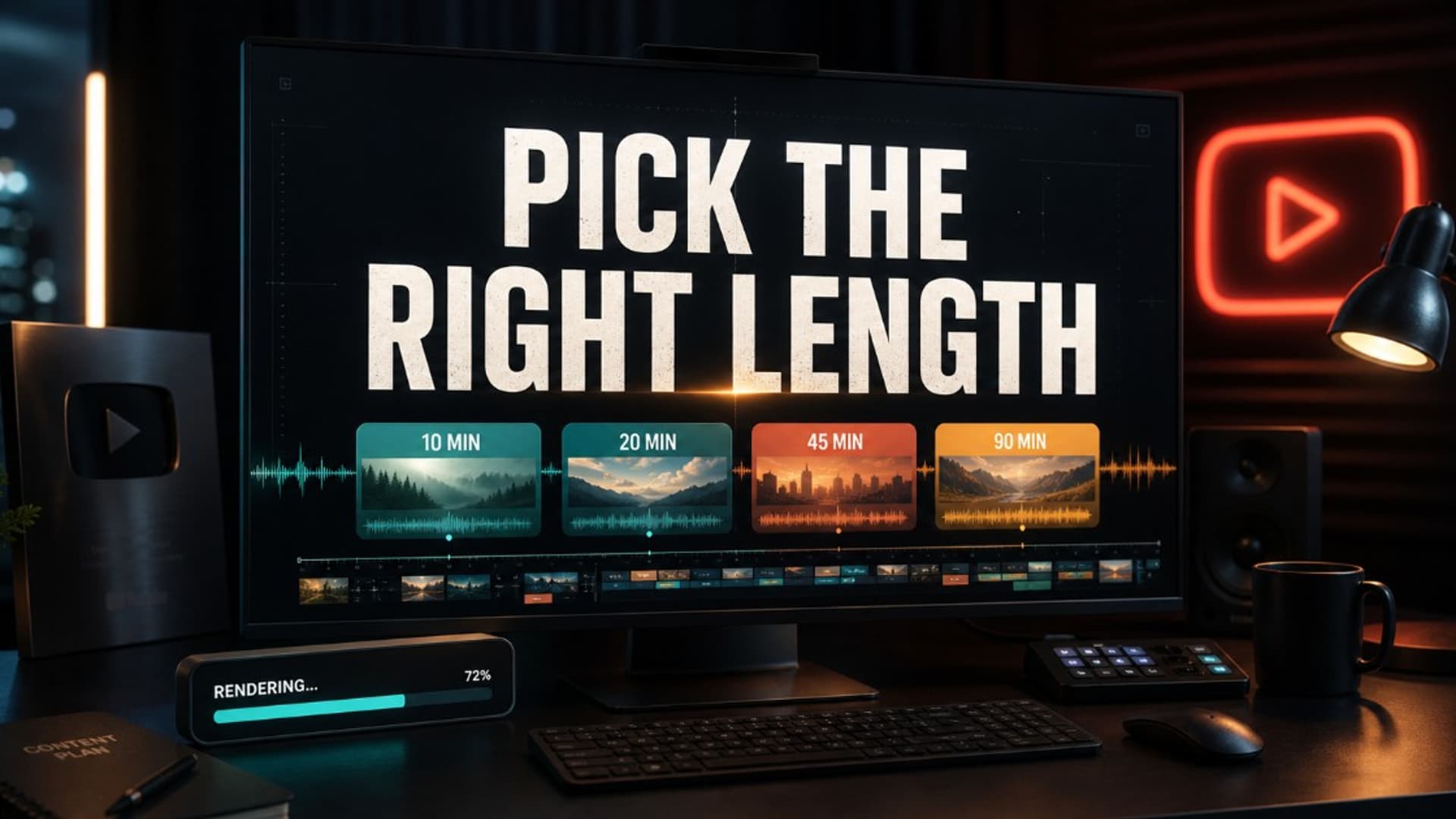
Most new faceless creators ask the length question too late.
They pick a niche, generate a script, choose a voice, collect visuals, and only then realize the episode is either too thin for 25 minutes or too dense for 8 minutes. The result is familiar: padded narration, repeated points, random B-roll, weak retention, and a render that took far more effort than the idea deserved.
In 2026, the better question is not “what is the longest video AI can make?” It is “what length gives this idea enough room to be satisfying without exposing the limits of my production system?”
That answer changes by niche, audience intent, and workflow maturity. A faceless mystery channel, a narrated sleep-history channel, and an AI explainer channel should not use the same default duration just because the software can technically export it.
Start With Viewer Intent, Not Tool Capacity
A video’s length should match the job the viewer is hiring it to do.
For search-driven explainers, viewers often want a complete answer without a long warm-up. A 10-18 minute video can work well when the topic is specific, the structure is tight, and the visuals support comprehension rather than simply filling time.
For documentary-style stories, the viewer is usually buying into a journey. A 20-45 minute runtime can make sense when there are real turns: setup, context, conflict, escalation, reveal, and conclusion. If the story only has two strong beats, stretching it into a documentary length will make it feel artificial.
For narrated sleep, history, mythology, science, and calm learning content, the value proposition is different. The viewer may want a longer, low-friction listening experience. In that case, 45-120 minutes can work, but only if the pacing, narration, and topic density are designed for relaxed attention.
The mistake is treating “long-form” as one bucket. A 12-minute explainer and a 90-minute sleep documentary are both long-form, but they are different products.
A Practical Length Ladder for Faceless Channels
If you are still early, use a ladder instead of guessing.
Start with 8-12 minutes when you are testing a new niche, voice, or format. This length is long enough to prove whether the topic can hold attention, but short enough that one failed upload does not consume a week of production.
Move to 15-25 minutes once you know the audience wants depth. This is often the useful middle ground for faceless documentaries, educational explainers, finance breakdowns, tech history, and story-based channels. It gives you room for a proper hook, chapters, examples, and a satisfying ending.
Use 30-60 minutes only when the topic naturally contains multiple sections. Think “the rise and fall of a company,” “the full timeline of a strange historical event,” or “the complete story behind a scientific mystery.” If you cannot outline at least five meaningful chapters, the video probably is not ready for this range.
Reserve 60-180 minutes for intentional passive-viewing formats: sleep history, mythology for sleep, calm science, study companion videos, and similar narrated experiences. These videos need a different writing style. They should reduce sharp tonal shifts, avoid overstuffed hooks, and maintain a steady rhythm.
Production Limits Still Matter
AI video tools have improved fast, but long-form production is still not magic. Fresh creator discussion in 2026 keeps circling the same bottleneck: individual AI video clips are easier to generate than a coherent 20-60 minute finished episode.
The hard part is continuity. You need a script that can be broken into scenes, visuals that do not drift wildly, voiceover that stays consistent, music that does not fatigue the viewer, and a render workflow that does not collapse under project length.
That is why the smartest length is often the longest length your system can produce repeatedly at acceptable quality.
A polished 16-minute video every week usually beats an overextended 50-minute video that takes a month and teaches the viewer to skip around. Longer videos can create more watch time, but only if they preserve trust. If the middle third feels padded, viewers notice.
Monetization Does Not Mean “Make Everything Longer”
Long-form video matters for monetization because watch time matters. YouTube’s Partner Program documentation says valid public watch hours from long-form videos count toward eligibility, and creators commonly build faceless channels around that path.
But the watch-hour incentive can push beginners into bad math. A 40-minute video with weak retention is not automatically better than a 14-minute video people finish. Total watch time comes from duration multiplied by actual viewer behavior.
The goal is not maximum length. The goal is durable session value.
For commercial niches like finance, software, history, business, science, and education, a tighter 12-25 minute video can attract better-qualified viewers than a padded upload. For sleep and passive learning niches, longer length can be part of the product, but only when the title, thumbnail, narration, and structure make that promise clear.
Also remember YouTube’s monetization policies around repetitive and mass-produced content. Longer does not protect a channel if every upload feels like the same template with different nouns. Length should create room for originality, not hide sameness.
Choose Length Before You Write the Script
The best time to choose runtime is before scripting.
For an 8-12 minute video, write one central question and three to five supporting sections. Keep examples sharp. Cut background that does not change the viewer’s understanding.
For a 15-25 minute video, plan chapters with distinct jobs: hook, context, first turn, deeper explanation, consequence, and payoff. Each section should earn its place.
For a 30-60 minute video, build a proper episode map. List every chapter, what changes in that chapter, what visuals it needs, and why the viewer should continue.
For a 1-3 hour sleep-style video, write for continuity rather than suspense. Use softer transitions, calmer phrasing, and fewer abrupt emotional spikes. The viewer may not be watching actively the whole time, but the piece still needs structure.
Length is a creative constraint. Once you set it, the script becomes easier to judge.
How AutoTube.pro Fits Into This Workflow
Once you know your target length, an all-in-one production system becomes much easier to evaluate.
AutoTube.pro is built for long-form faceless YouTube creators who want the full pipeline in one place: idea -> script -> voiceover -> media -> render -> thumbnail. That matters because video length affects every step. A 12-minute explainer needs different pacing than a 90-minute sleep-history episode, and the workflow should keep those decisions connected instead of scattering them across separate tools.
For creators producing 5-minute to 3-hour videos, the main advantage is consistency. You can build the script, generate narration, create visuals, render the final video, and prepare the thumbnail without rebuilding the production stack for every runtime.
The built-in Canvas-style thumbnail editor also matters here. A 12-minute explainer and a 90-minute sleep video usually need different thumbnail promises. One may sell clarity and speed. The other may sell calm depth. Keeping thumbnail creation close to the episode workflow helps the packaging match the actual video.
FAQ
How long should a new faceless YouTube video be?
For most new channels, 8-15 minutes is a good testing range. It is long enough to prove topic quality and retention, but short enough to produce consistently while you learn the niche.
Are longer faceless videos better for monetization?
Not automatically. Longer videos can generate more watch time, but only if viewers stay engaged. A focused 15-minute video can outperform a padded 40-minute video if retention and satisfaction are stronger.
Can AI-generated faceless videos be monetized on YouTube?
AI-generated content can be monetizable when it is original, valuable, and compliant with YouTube policies. Channels can run into trouble when content is repetitive, reused, misleading, or mass-produced with little added value.
Does YouTube penalize AI voiceover?
YouTube does not ban AI voiceover by default. The bigger issues are originality, viewer value, rights, disclosure when required, and whether the content feels repetitive or low effort.
Should sleep-style faceless videos be longer?
Often, yes. Narrated sleep-history, mythology, and calm science videos can work at 45-120 minutes because the viewer expects a slower experience. The script still needs structure, but the pacing should be softer than a normal documentary.
If your current workflow makes every runtime feel equally messy, start by choosing one length band and building a repeatable process around it. AutoTube.pro is designed for that kind of long-form faceless production system.