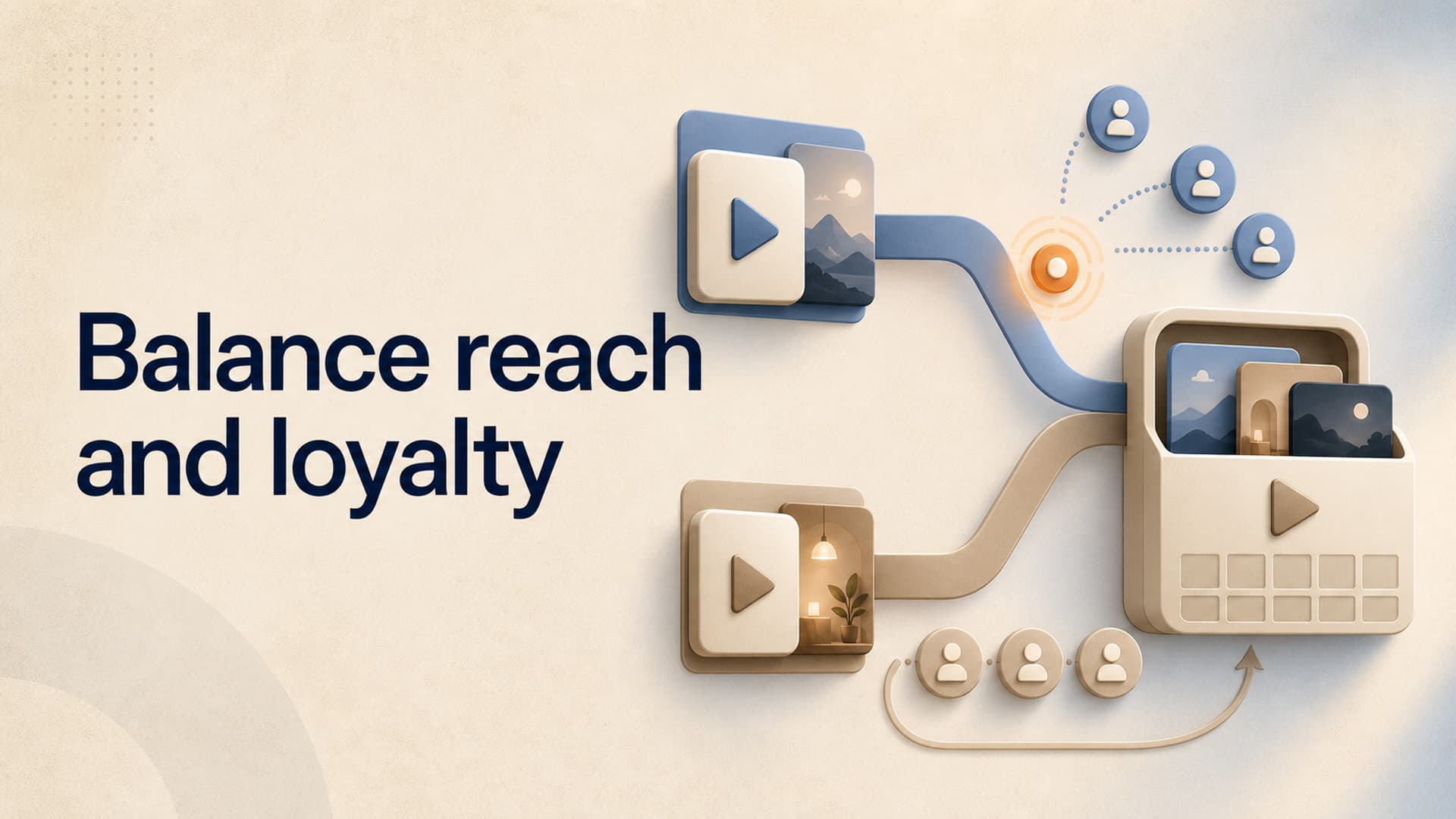
Most faceless channels ask one video to do two incompatible jobs.
They want it to reach strangers who know nothing about the channel, while also rewarding the people who already understand its format, recurring ideas, and point of view. The result is often a compromise: too much explanation for loyal viewers, but too many assumptions for newcomers.
YouTube Studio now separates the audience into new, casual, and regular viewers. Treat those labels as more than a reporting detail. They can become a practical way to decide what kind of video to make next.
The goal is not to maximize one segment. A healthy long-form channel needs an acquisition path and a return path. Discovery brings people through the door. Familiarity gives them a reason to come back.
The Three Viewer Segments Describe Different Relationships
A new viewer is meeting the channel for the first time in the selected period. They need a promise they can understand without context. A casual viewer has returned occasionally. They recognize the territory, but the channel is not yet part of their routine. A regular viewer has watched consistently over a much longer period and represents the most established audience relationship.
These are not quality scores, and YouTube says the segments do not directly affect reach or monetization. They are better understood as evidence of audience behavior.
That distinction matters. A low regular-viewer count does not automatically mean the channel is failing. Newer channels and channels built around timely search topics naturally attract more first-time viewers. Meanwhile, a channel can have a loyal core and still plateau because its videos make little sense to anyone outside that core.
Instead of chasing a universal ratio, ask a more useful question: Which viewer relationship is this next video designed to strengthen?
Discovery Videos Need a Complete Promise
A discovery video should stand on its own. Its title names a problem, mystery, outcome, or question that a stranger already cares about. The opening delivers enough context to make the stakes clear, without forcing the viewer to know the previous upload.
For a faceless history channel, “Why Medieval London Smelled Worse Than You Imagine” is a discovery idea. A viewer can understand the promise immediately. “The City Files, Episode 14” is not. The series label may help an established audience, but it consumes valuable title space without helping a stranger decide.
Discovery videos usually benefit from:
- A topic with recognizable demand outside the channel
- A title and thumbnail that communicate one complete idea
- An opening that pays off the packaging within the first 30 seconds
- Minimal dependence on channel lore or a previous episode
- A structure that introduces specialist terms before using them
This does not mean every discovery video should be broad. Specificity often makes a promise stronger. The important part is that the viewer can evaluate it without already trusting the creator.
Loyalty Videos Can Spend the Trust You Have Earned
Videos for returning viewers can go deeper, slower, or stranger. The creator does not need to rebuild the entire relationship in the introduction. A familiar format, recurring narrator, or continuing investigation can carry part of the promise.
That creates room for topics that are less searchable but more distinctive: the second half of a historical mystery, a recurring “failed inventions” series, or a three-hour sleep documentary built around a narrow scientific question.
The common mistake is to translate loyalty into repetition. Regular viewers do not return because every upload is interchangeable. They return because the channel reliably delivers a particular kind of satisfaction while still giving them something new.
A useful test is to compare the substance of two adjacent videos. If you can swap their nouns and keep the same argument, examples, pacing, and visual sequence, you do not have a series. You have a template with superficial variation.
Loyalty videos should preserve the recognizable frame while changing the intellectual payload.
Use Bridge Videos to Turn Reach Into Habit
Discovery and loyalty are not the only choices. Bridge videos connect them.
A bridge video starts with an accessible promise but leads into a format the channel can repeat. Imagine a faceless science channel gets unusual reach from “What Happens to Your Body After 36 Hours Without Sleep?” The next upload should not be a random broad topic just because broad worked once. A stronger bridge might be “Why Your Brain Invents Patterns When You Are Exhausted.” It remains understandable to a newcomer while establishing the channel's deeper focus on unusual human biology.
Bridge videos are where casual viewers are often made. They give a first-time viewer a second reason to click without simply producing a sequel that requires the original.
Three practical bridge patterns are:
The Adjacent Question
Take the strongest unresolved question from a successful video and make it independently understandable. The new upload should complement the winner, not summarize it.
The Reusable Lens
Apply the channel's distinctive approach to a new subject. A history channel might consistently explain daily life through food, labor, and sleep rather than chronological summaries.
The Format Premiere
Use a broadly appealing topic to introduce a repeatable format. If it works, retain the mechanics but change the substance in the next episode.
A Six-Video Portfolio Beats Six Identical Bets
For the next six uploads, assign each video a job before scripting:
| Role | Number of videos | Primary job |
|---|---|---|
| Discovery | 3 | Reach qualified new viewers |
| Bridge | 2 | Turn first-time interest into a second view |
| Loyalty | 1 | Deepen the relationship with returning viewers |
This 3-2-1 mix is a starting hypothesis, not a platform rule. A young channel may lean harder into discovery. An established channel with reliable browse traffic may use more bridge and loyalty episodes. The value is in making the tradeoff explicit.
For every upload, write down four things before production begins:
- The intended viewer segment
- The promise that segment can understand
- The familiar element being retained
- The substantial element that is changing
Then evaluate the portfolio after enough time has passed for retention and audience data to settle. YouTube notes that audience-retention data typically takes 1-2 days to process, so judging the opening immediately after publishing can be misleading.
Do not grade every role with the same metric. A discovery video may earn a high share of new viewers but fewer immediate returns. A loyalty video may reach fewer people while producing stronger watch time among regular viewers. Bridge videos should be examined for whether viewers move into more of the channel's library.
Read Retention Together With Viewer Type
Viewer segments tell you who showed up. Retention helps explain what happened after they clicked.
Start with the first 30 seconds. YouTube's intro measure shows what percentage of the audience is still watching after that point. If a discovery video loses viewers immediately, compare the opening against the title and thumbnail. The problem may be broken expectation rather than topic quality.
Next, inspect dips and spikes. A dip can signal that viewers skipped an overlong explanation, repetitive visual sequence, or detour. A spike may mean a moment was compelling enough to rewatch, but it can also mean the explanation was unclear. Watch the segment before deciding which interpretation fits.
Finally, compare new and returning viewers when the report has enough data. If newcomers leave during references to earlier episodes, the video probably assumed too much context. If returning viewers leave during a long basic explanation, the introduction may be rebuilding trust they already gave you.
The useful unit is not a single retention percentage. It is the mismatch between the video's intended job and the audience response.
Keep the System Repeatable Without Making It Repetitive
This portfolio approach becomes difficult when every experiment requires rebuilding the production workflow. Creators often respond by locking everything into one rigid template, which saves time but makes the channel feel mass-produced.
A better boundary is to standardize production decisions while keeping editorial decisions open. Save stable choices such as narration style, subtitle treatment, visual direction, and render settings. Reconsider the premise, evidence, structure, examples, and pacing for every video.
That is where AutoTube.pro can help as one production option. Reusable channel presets keep the repeatable parts consistent across uploads, while the step-by-step pipeline lets a creator pause and revise the script or media before continuing. Its research-backed script generation is especially useful for bridge videos, where an accessible premise still needs enough original substance to earn a second view.
The point is not to automate the editorial distinction away. It is to remove setup work so more attention can go into deciding whether an upload is meant to attract, convert, or retain.
Build a Channel People Can Enter and Return To
A channel made only for new viewers feels like a collection of disconnected search results. A channel made only for regular viewers becomes a private conversation that outsiders cannot enter.
Plan both paths. Give strangers a complete promise, give casual viewers a nearby next step, and give regular viewers depth that rewards their trust. If your current tool stack makes that rhythm harder than it should be, AutoTube.pro offers a practical way to keep the production system stable while the editorial choices remain genuinely varied.