A lot of faceless YouTube advice starts in the wrong place.
It asks, “What niche should I choose?” or “Which AI video tool should I use?” Those questions matter, but they are downstream from a more useful decision: what production format can you repeat for 20, 50, or 100 long-form videos?
A niche is the subject. A format is the operating system.
Two channels can both cover history, psychology, finance, science, or strange internet stories. One might publish calm narrated documentaries. Another might make fast-paced explainers with chaptered arguments. Another might create fictional case files with recurring characters and atmospheric visuals. Same broad niche, completely different workload.
That distinction matters more in 2026 because long-form faceless creators are no longer only competing with other small channels. They are competing with AI-assisted production systems, better synthetic voiceovers, more polished visual generators, and stricter expectations around original, non-repetitive content. YouTube’s own monetization guidance emphasizes originality, authenticity, and avoiding repetitive or mass-produced content, while its altered-content rules focus on realistic synthetic media that could mislead viewers.
So the better question is not “Can AI make this video?” It is: “Can this format create a recognizable, valuable channel without collapsing into generic output?”
Start With Format, Not Topic
A topic list feels productive because it gives you dozens of possible videos. But a topic list does not tell you how each episode will be built.
A production format answers questions like:
- What does the first minute always do?
- How is the video divided into sections?
- What kind of narration carries the episode?
- What visual language repeats without feeling copy-pasted?
- How long should each episode be?
- What proof, examples, story beats, or sources does each video need?
- What makes the channel recognizable after five uploads?
This is where many new faceless channels break. They choose a niche, publish one decent video, then reinvent the whole process next week. The second script has a different pacing model. The third uses a different voice. The fourth changes visual style. The fifth takes twice as long because there was never a repeatable production path.
A strong format turns a channel from a collection of prompts into a system.
The Four Long-Form Formats Worth Comparing
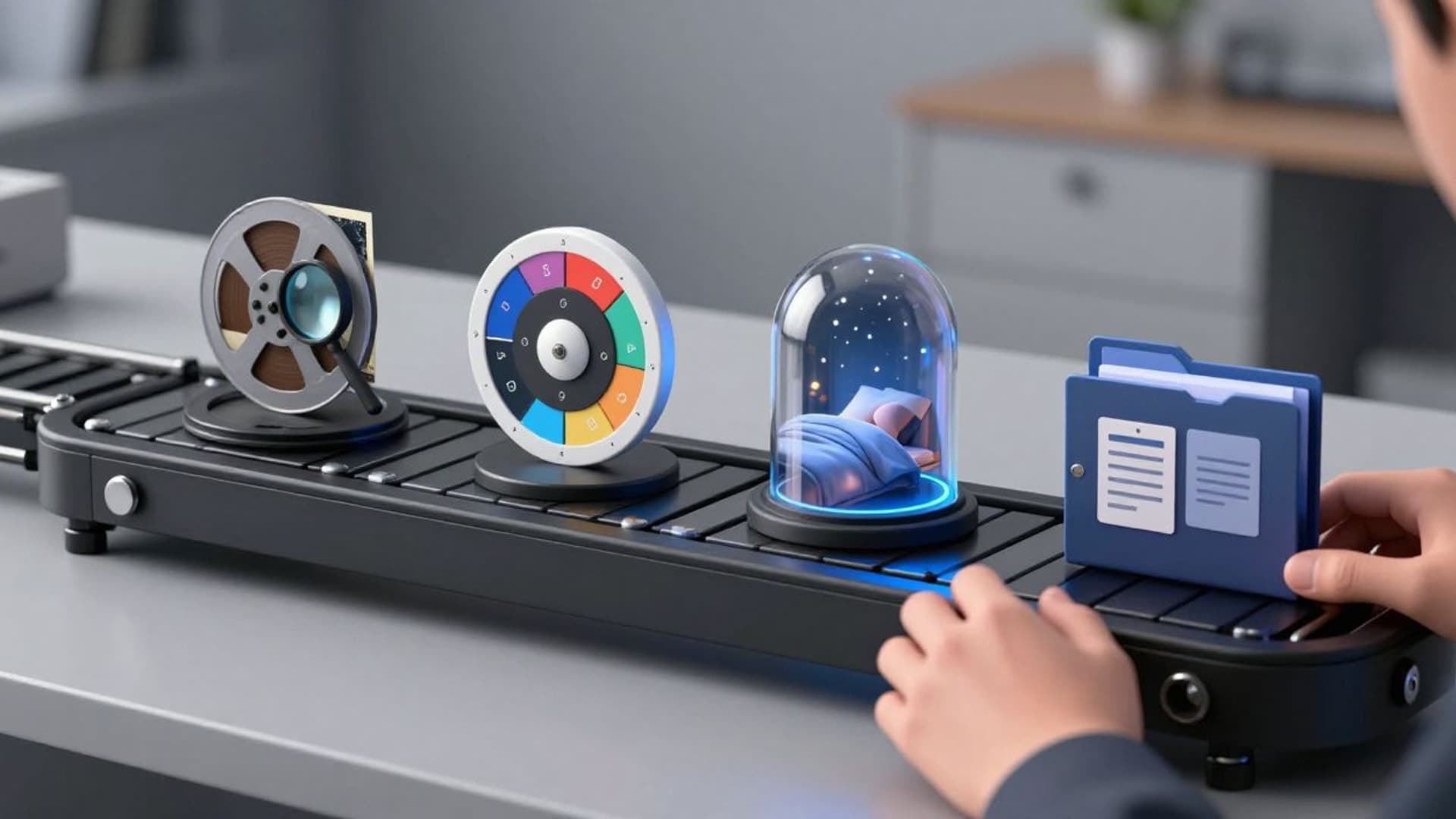
Most beginner faceless creators should compare four production formats before they pick software or build a calendar.
1. Narrated Documentary
This format works well for history, science, crime-adjacent analysis, business breakdowns, geopolitics, culture, and biography.
Its strength is depth. Viewers accept slower pacing if the story is coherent, researched, and visually grounded. The production burden is also higher. You need a stronger outline, better source notes, more careful transitions, and enough visual variation to sustain attention for 20-60 minutes.
Choose this format if you enjoy research and can turn facts into a sequence of tension, context, and payoff. Avoid it if you want to publish quickly with shallow prompting. Documentary audiences can forgive a faceless channel. They are less forgiving of vague writing.
2. Chaptered Explainer
This format works for finance, technology, AI tools, productivity, psychology, health education, and “how it works” topics.
The structure is usually cleaner than documentary: promise, context, mistake, framework, examples, takeaway. It is easier to template because each section has a job. The risk is sounding like a generic blog post read aloud.
Choose this format if your channel can give practical clarity. The best chaptered explainers feel like someone organized the viewer’s confusion. They do not need cinematic drama, but they do need tight scripts, plain examples, and visual support that makes ideas easier to understand.
3. Atmospheric Sleep Narration
This format is built for long session time: calm history, mythology, biology, space, ancient civilizations, folklore, and gentle educational storytelling.
The viewer is not always watching closely, but that does not mean the script can be lazy. In fact, the format has its own discipline: soft pacing, low-friction sentence structure, minimal jump scares, smooth transitions, and narration that does not suddenly become too energetic.
Choose this format if you can maintain consistency for 60-180 minutes. Avoid it if your only plan is to stretch a normal documentary script. Sleep content is not just “longer and slower.” It needs a different rhythm.
4. Fictional Story or Case File
This format works for AI stories, mysteries, alternate histories, sci-fi logs, horror-adjacent narration, and serialized fictional worlds.
Its strength is repeatability. Once you define the world, narrator, episode structure, and visual identity, the channel can become easier to scale. The risk is sameness. If every episode follows the same emotional curve, viewers will feel the template too clearly.
Choose this format if you can build recurring premises and keep continuity clean. It benefits from a simple internal bible: names, rules, visual motifs, voice, episode length, and what the channel never does.
Score the Format Before You Score the Idea
Before choosing a format, score it against five practical constraints.
First, script complexity. Can you write this format weekly without quality falling apart? A 45-minute documentary may be attractive, but if every episode needs heavy research, your upload cadence may suffer.
Second, visual load. Some formats need constant image changes, maps, diagrams, or stock footage. Others can survive with slower visual movement, atmospheric stills, or fewer scene changes. If the format demands more visuals than you can reliably produce, it will become expensive or inconsistent.
Third, voiceover tolerance. Some formats expose weak narration immediately. Sleep narration, documentaries, and fictional stories all rely heavily on voice quality. If the voice feels robotic, rushed, or emotionally mismatched, the whole video suffers.
Fourth, monetization fit. YouTube does not reject a channel just because it is faceless or AI-assisted, but channels still need original, non-repetitive value and rights-cleared assets. A format built around copied clips, generic narration, or mass-produced near-duplicates is fragile. A format built around original structure, commentary, research, or storytelling is stronger.
Fifth, repeatability. The format should be specific enough to guide production but flexible enough to produce many episodes. If it only works for three ideas, it is not a channel format. It is a mini-series.
Build a One-Page Format Bible
Once you choose a format, write a one-page format bible before producing the next video.
Keep it simple:
- Channel promise: what viewers consistently come for.
- Episode length: the normal range, not a fantasy maximum.
- Opening pattern: how each video earns the first 60 seconds.
- Section structure: the recurring chapter model.
- Narration style: calm, investigative, explanatory, cinematic, or story-led.
- Visual style: stock-led, AI image-led, diagram-led, archive-led, or hybrid.
- Source rules: what must be researched, cited, or avoided.
- Repetition rules: what should stay consistent and what must vary.
- Upload checklist: script, voiceover, visuals, render, thumbnail, description, disclosure review.
This document prevents tool choices from running the channel. It also makes AI more useful, because every prompt has a stable creative target. Instead of asking an AI system to invent the channel from scratch each time, you are giving it a production grammar.
How AutoTube.pro Fits Into This Workflow
Once the production format is clear, AutoTube.pro can help turn that format into a repeatable long-form pipeline.
The platform is built for faceless creators who want to move from idea to script, voiceover, media, render, and thumbnail without stitching together a half-dozen disconnected tools. That matters most after the format decision is made. A documentary format needs a different script rhythm and visual plan than a sleep narration format. A chaptered explainer needs different pacing than a fictional case file.
Use AutoTube.pro as the production layer, not as a substitute for format thinking. Define the channel promise, episode structure, narration style, and visual language first. Then use the platform to make those choices easier to repeat across uploads.
For long-form creators, this is the real advantage of an all-in-one workflow. The goal is not simply to make one AI video faster. It is to make the tenth video feel like it belongs to the same channel as the first one, with fewer manual handoffs and fewer places for quality to drift.
FAQ
What is a production format for a faceless YouTube channel?
A production format is the repeatable structure behind your videos. It includes episode length, pacing, narration style, visual approach, section structure, and quality rules. It is more operational than a niche.
Can faceless AI YouTube channels still be monetized?
Yes, faceless and AI-assisted channels can be monetized when they add original value and follow YouTube’s policies. The risky version is repetitive, mass-produced content with little transformation, unclear rights, or misleading synthetic media.
Does YouTube penalize AI voiceover?
YouTube does not broadly ban AI voiceover. The bigger issue is whether the overall content is original, valuable, non-repetitive, and compliant with monetization and disclosure rules. A weak generic voice can also hurt retention even if it does not create a policy issue.
How long should long-form faceless videos be?
The right length depends on the format. Explainers may work well at 10-25 minutes, documentaries often fit 20-60 minutes, and sleep narration can run much longer. The video should be as long as the viewer’s intent can support.
Should I choose my niche or my format first?
Choose both together, but do not stop at the niche. A niche tells you what the channel covers; the format tells you how every episode gets made. If you only choose a niche, production decisions stay vague.
A faceless channel becomes much easier to build when the format is clear. Pick the repeatable structure first, then let your tools serve that structure instead of replacing it.