Most weak faceless videos do not fail because the creator used AI. They fail because the AI was asked to invent the whole episode from a thin prompt.
That works for a short test video. It breaks down when you are trying to make a 20, 40, or 90 minute video that has to hold attention, sound credible, and survive monetization review. Long-form YouTube rewards specificity. The viewer can feel when a script has real source material behind it, and they can also feel when it is just a padded summary of common internet knowledge.
Before AI writes the script, you need a research layer.
This does not mean building an academic archive or spending three days on every upload. It means giving your production system enough raw material to create a video that feels intentional, not generic.
Why Research Matters More in Long-Form Faceless Videos
A faceless creator has fewer trust signals than an on-camera creator. There is no host's face, studio, field footage, or visible personality doing the credibility work. The script, narration, visuals, and structure carry almost everything.
That makes research especially important in niches like documentaries, explainers, sleep history, biography, finance explainers, science, mythology, and business stories. In these formats, viewers are not just watching for motion. They are listening for judgment.
A researched video usually has three qualities:
- It includes details that a generic prompt would miss.
- It has a clear point of view instead of a flat encyclopedia tone.
- It gives the visual system concrete things to show.
The third point is easy to underestimate. Better research does not only improve the words. It improves the whole video because the visual plan becomes more specific. Instead of asking for vague scenes like "ancient city at night," you can ask for a particular setting, era, object, map, diagram, room, artifact, or sequence.
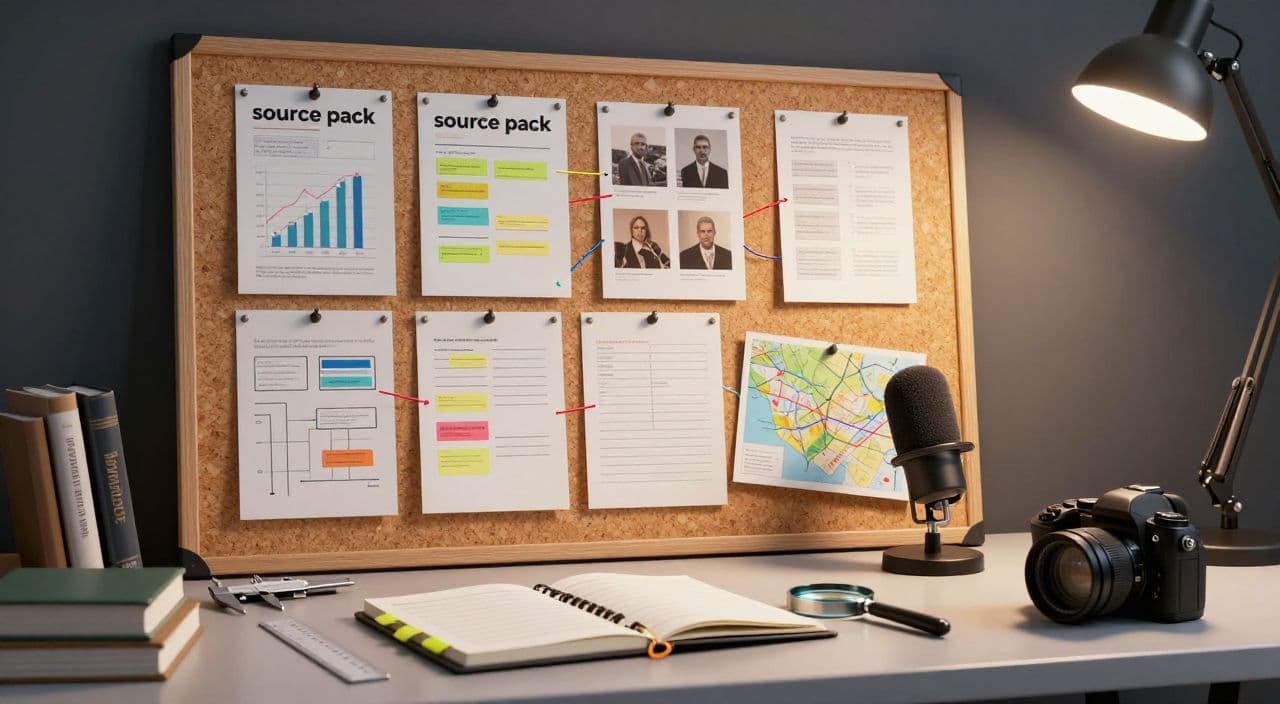
The Simple Source Pack Every Video Needs
For most long-form faceless videos, you do not need hundreds of sources. You need a compact source pack that gives the script enough shape.
A practical source pack includes:
- 3-6 primary facts or events the video must cover.
- 3-5 supporting details, examples, or anecdotes.
- A list of terms, names, dates, places, or mechanisms that must be accurate.
- A few visual anchors that should appear in the video.
- One central question the viewer should want answered.
- One opinionated angle that makes the video feel curated.
For example, a boring history sleep video should not start with "write a 2 hour video about the Roman Empire." It should start with a source pack around a narrower promise, such as the daily life of Roman night workers, the economics of oil lamps, the layout of apartment blocks, and the sounds and routines of the city after sunset.
That gives the AI something to develop. More importantly, it gives you something to judge.
Turn Research Into a Script Brief
The mistake is dumping research into an AI tool and asking for a finished script immediately. That often creates a script that includes the facts but still feels shapeless.
A better workflow is to turn the source pack into a script brief first.
The brief should answer:
- Who is the viewer?
- What promise does the video make in the first minute?
- What should the viewer understand by the end?
- Which facts are mandatory?
- Which facts are optional?
- What tone should the narration use?
- What should the pacing feel like?
- What should the visuals avoid?
This step is small, but it changes the quality of the output. AI is much stronger when it is executing a clear editorial brief than when it is guessing the format, audience, structure, and level of detail at the same time.
For long-form videos, the brief should also define the section rhythm. A 45 minute explainer might need a hook, context, 5 main chapters, a recap, and a forward-looking conclusion. A 2 hour sleep documentary might need slower transitions, lower drama, repeated orientation, and less aggressive cliffhanging.
Research is not just about accuracy. It is about matching the information to the viewing situation.
Build a Visual Research Layer Too
Faceless creators often research the script but leave the visuals vague. That creates a second problem later: the video sounds specific but looks generic.
For every major section, create a short visual note. This can be simple:
- Places: cities, rooms, landscapes, interiors, factories, ships, temples, laboratories.
- Objects: tools, documents, machines, clothing, maps, food, artifacts.
- Motions: walking, assembling, observing, traveling, writing, repairing, preparing.
- Visual style: calm, cinematic, archival, illustrated, diagrammatic, realistic, low-stimulation.
This helps whether you use AI images, AI video clips, stock footage, or a mix. It also reduces the chance that every episode in your channel looks like the same generic montage with different narration.
Good visual research gives the production system constraints. Constraints are what make AI output feel less random.
Avoid These Research Mistakes
The first mistake is collecting too much. If you gather 40 links for one video, you may feel productive, but you have probably created a sorting problem. For beginner and intermediate creators, a smaller, cleaner source pack usually works better.
The second mistake is researching only facts. Facts matter, but long-form videos also need tension, order, and emphasis. Ask what the viewer is supposed to wonder, not only what they are supposed to learn.
The third mistake is letting AI summarize sources without adding judgment. Summary is not the same as a video angle. Two creators can use the same sources and make completely different episodes because they choose different questions, pacing, and examples.
The fourth mistake is skipping source notes for visuals. If the video needs 80 or 200 visual moments, vague prompts will catch up with you quickly.
How AutoTube.pro Fits Into This Workflow
Once the research layer is clear, AutoTube.pro can help turn it into a repeatable long-form production process.
The platform is built for faceless creators who want one connected pipeline instead of a pile of disconnected tools. You can use your source pack and script brief to guide the script, then continue through AI voiceover, media generation, rendering, and thumbnail creation inside the same workflow.
That matters because research loses value when it gets scattered across separate tabs and tools. A strong brief should influence the narration, the scene prompts, the visual pacing, and the final packaging. If each stage happens in a separate app, the original intent often gets watered down.
For documentary, explainer, AI story, and narrated sleep channels, the goal is not just to create more videos. It is to create a format where every episode has a recognizable level of depth. Research is the input. The production system is how that input survives all the way to the final upload.
FAQ
Do faceless YouTube videos need research to be monetized?
Research is not a formal monetization requirement by itself. But YouTube's monetization rules care about original, authentic, and non-repetitive content, so research can help your videos feel more substantial and less mass-produced. It also makes it easier to add commentary, structure, and value beyond generic summaries.
Can AI write a good long-form script from one prompt?
Sometimes it can produce a usable draft, but one-prompt scripts usually become thin as the video gets longer. For 20 minutes or more, a brief with sources, structure, audience, and visual notes gives the AI a much better target. The longer the video, the more important the preparation becomes.
Does YouTube penalize AI voiceover?
YouTube does not automatically penalize a video just because it uses AI voiceover. The bigger issues are whether the content is original, useful, and not misleading. A researched script with clear structure is usually a stronger foundation than generic narration over generic visuals.
Is AI-generated faceless content monetizable?
AI-generated content can be monetizable when it adds original value and follows YouTube's policies. Channels run into problems when videos are repetitive, low-effort, misleading, or mostly reused material. A research-first workflow helps because it pushes the creator toward more specific scripts and more deliberate production choices.
How long should researched faceless videos be?
The right length depends on the niche and the viewer intent. Explainers and documentaries often work well in the 20-60 minute range, while narrated sleep or background-learning formats can run 1-3 hours when the pacing is intentionally calm. Do not stretch a topic just to hit a length target; build the length from the depth of the source material.
Final Thought
AI can speed up production, but it should not replace the thinking that makes a video worth watching. If you want long-form faceless videos that feel specific, repeatable, and easier to produce, start by building a better research layer.
Then let the tools do what they are good at: turning a clear idea into a finished video.