Most weak AI video scripts do not fail because the prompt was too short. They fail because the model was asked to write before the creator knew what the video was actually built from.
That matters more in long-form than it does in quick social content. A 30-minute explainer, documentary, sleep-history episode, finance breakdown, or mystery story cannot survive on a clever opening and a few generic facts. It needs source material, boundaries, examples, narrative direction, and a repeatable way to turn research into scenes.
A source pack is the missing step between “I have an idea” and “write the script.” It is a compact working folder that tells your AI writing process what to use, what to avoid, what the viewer came for, and how the finished video should feel.
What a Source Pack Actually Is
A source pack is not a giant dump of links. It is a curated production input for one video or one repeatable series format.
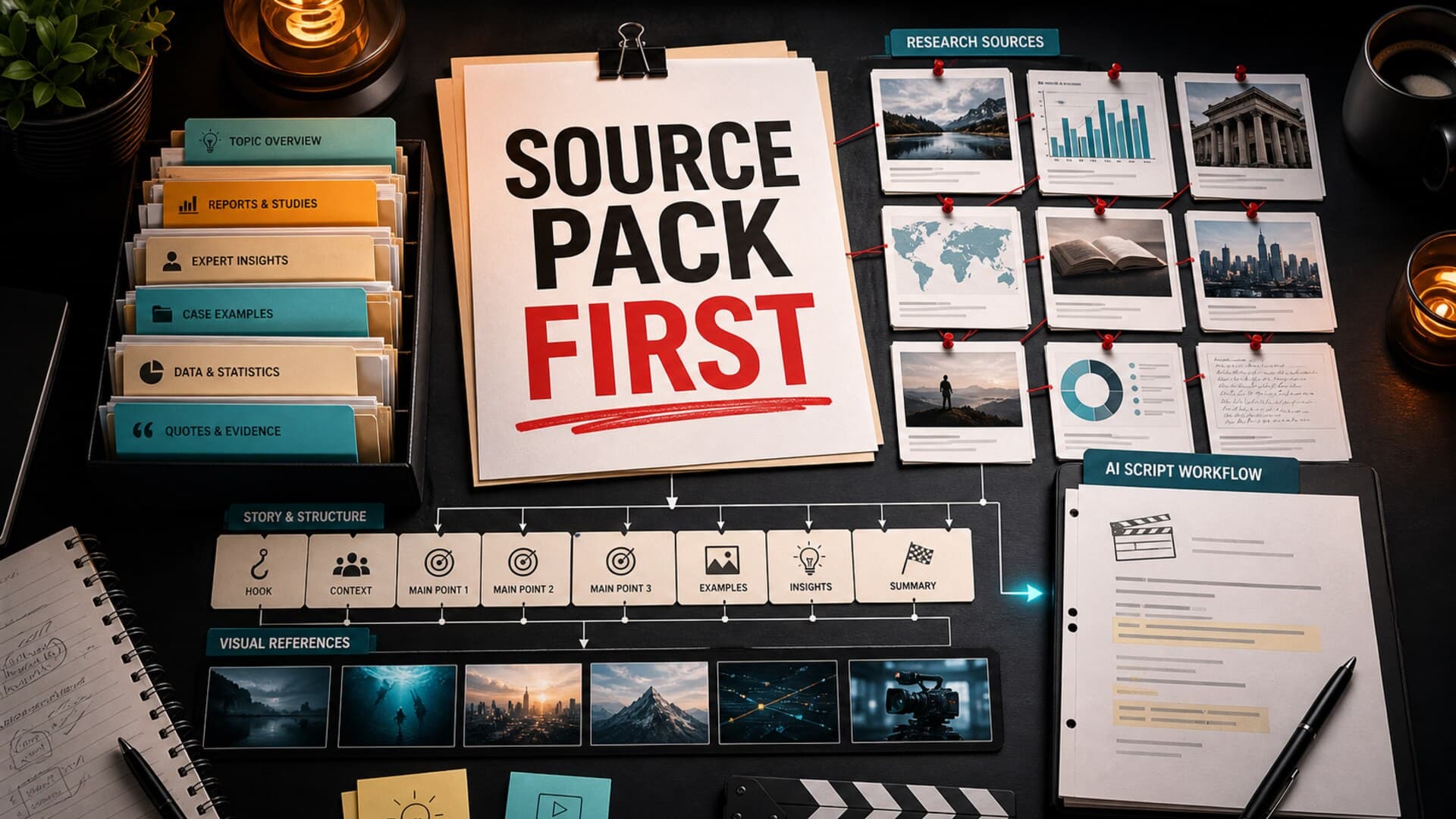
For a long-form faceless video, a good source pack usually includes:
- The core topic promise
- 5-10 trusted sources or reference notes
- The strongest facts, examples, dates, or story beats
- Viewer questions the script should answer
- Claims that need careful wording
- Visual moments that should become scenes
- Tone notes for the narrator
- A short list of things the script should not say
The point is not to make the AI “more factual” by magic. The point is to reduce ambiguity before writing starts. When the input is cleaner, the script is easier to review, easier to visualize, and less likely to drift into generic filler.
This has become more important as creators use AI research tools, transcript summaries, and document-based chat workflows. Those tools can speed up research, but they can also create a false sense of completeness. A source pack forces you to decide what actually belongs in the episode.
Why Long-Form Scripts Need More Than Prompts
Long-form YouTube rewards depth, pacing, and trust. Viewers may forgive a rough sentence. They are less forgiving when a video repeats itself for 20 minutes, makes claims it cannot support, or sounds like a Wikipedia summary with a voiceover.
A prompt can describe the desired script. A source pack gives the script something specific to stand on.
This is especially useful for faceless channels because the viewer is judging the production through structure, narration, visuals, and topic quality. There is no host personality to cover weak research. If the story is thin, the whole video feels thin.
A source pack also helps avoid a common AI workflow mistake: asking for a finished script too early. The better order is:
- Define the topic promise.
- Build the source pack.
- Extract the video outline.
- Write the first draft.
- Review claims, pacing, and scene coverage.
- Produce voiceover and visuals.
That sequence is slower at the beginning, but faster across the full production cycle. You spend less time rewriting, less time inventing visuals after the fact, and less time fixing sections that should never have made it into the draft.
The Minimum Source Pack for One Long-Form Video
You do not need a research database to start. A practical source pack can fit in a single document.
1. Topic Promise
Write one sentence that explains why the viewer would click and stay.
Weak: “A video about ancient Rome.”
Stronger: “A calm 90-minute sleep-history episode about the ordinary jobs, street sounds, meals, and routines of people living in ancient Rome.”
The stronger version already tells the writer what to include, what tone to use, and what kind of details matter.
2. Source List
Add the sources you actually want the script to rely on. For current events, policy, finance, health, legal, or science topics, prefer primary or reputable sources. For history and documentary topics, mix primary references, credible summaries, museum pages, books, and expert material where possible.
Do not include sources just because they appeared in search results. If a source is low quality, vague, or content-farmed, leave it out.
3. Extracted Notes
Pull out the useful details before asking for a script. This is the difference between research and link hoarding.
For each source, capture:
- Key facts or claims
- Specific examples
- Useful quotes or paraphrased ideas
- Dates, names, locations, and definitions
- Anything that needs cautious wording
This step also makes later fact-checking easier because you know where the important claims came from.
4. Viewer Questions
List the questions a real viewer would have. These questions often become section headings, transitions, or retention moments.
For example:
- Why did this system exist?
- What did ordinary people experience?
- What changed over time?
- What do people usually misunderstand?
- Why does this matter now?
Viewer questions keep the script from becoming a flat sequence of facts.
5. Scene Notes
Long-form scripts are easier to produce when visual thinking starts early. Add moments that could become visuals: maps, documents, rooms, machines, characters, timelines, diagrams, or atmospheric scenes.
For AI-generated visuals, this also helps preserve consistency. Instead of inventing image prompts late in the process, you can build scenes from the same research spine as the script.
How to Turn a Source Pack Into a Script Outline
Once the source pack exists, do not jump straight to a full script. Ask for an outline first.
A strong outline should include:
- A hook that matches the topic promise
- 5-8 major sections for a standard long-form video
- Notes on which sources support each section
- Retention beats where the viewer gets a new reason to keep watching
- Suggested visual moments for each section
- A calm ending that completes the promise
This outline is where you catch most structural problems. If one section has no source support, it probably needs more research. If three sections repeat the same point, combine them. If the visual plan is empty, the topic may be too abstract or the source pack may need more concrete material.
For narrated sleep content, the outline should be softer and less dramatic. For documentaries and explainers, it can carry more contrast, tension, and argument. The source pack should make that choice clear before writing begins.
Common Mistakes to Avoid
The first mistake is using too many sources. More links do not automatically produce a better script. A smaller set of stronger sources usually beats a bloated folder full of half-relevant pages.
The second mistake is treating AI summaries as final research. Summaries are useful for navigation, but they still need judgment. Check important claims against the source material before they become narration.
The third mistake is skipping negative instructions. If the video should avoid speculation, exaggerated claims, modern political framing, or graphic detail, say so in the source pack. The absence of boundaries is one reason AI scripts drift.
The fourth mistake is separating research from production. If the source pack only helps the script, it is underused. It should also support voice direction, visual planning, title ideas, thumbnail angles, and the final review pass.
How AutoTube.pro Fits Into This Workflow
A source pack is most valuable when it can move through the whole production process without being rebuilt in five different tools.
AutoTube.pro is designed for long-form faceless creators who want that pipeline to stay connected: script -> voiceover -> media -> render -> thumbnail. Instead of treating the script as a disconnected document, you can use the same production thinking to guide narration, AI media, stock footage, rendering, and thumbnail creation.
That matters when you are building repeatable channels. A source pack can define the episode promise, the structure, the tone, and the visual direction. Then the rest of the workflow can follow the same spine instead of becoming a series of manual handoffs.
For creators making sleep-history videos, AI documentaries, explainers, and story-driven channels, this is the difference between producing isolated uploads and building a recognizable format.
FAQ
Do AI video scripts need sources?
Yes, if the video makes factual claims, teaches a topic, explains history, covers finance, or presents documentary-style material. Sources make the script easier to trust and easier to review. Even fictional or story-based videos benefit from reference material for tone, structure, and worldbuilding.
Does YouTube penalize AI-written scripts?
YouTube does not automatically penalize a video just because AI helped write it. The risk is low-value, repetitive, misleading, or mass-produced content that does not add enough originality. A source pack helps because it pushes the script toward specific research, clearer structure, and human editorial judgment.
Is AI-generated content monetizable on YouTube?
AI-generated content can be monetizable when it follows YouTube policies and offers original value. Creators should be especially careful with reused content, misleading synthetic media, rights issues, and repetitive production. The safest workflow includes research, review, disclosure when required, and clear creative input.
How many sources should a long-form faceless video use?
For most beginner-to-intermediate creators, 5-10 strong sources is enough for a focused long-form video. More may be needed for complex documentaries, but the key is relevance and quality. A bloated source list often creates more confusion than depth.
Should I write the full script before planning visuals?
Usually, no. Plan visual moments while building the outline so the script is easier to produce later. This is especially important for faceless videos, where visuals carry much of the viewer experience.
A good source pack will not make every video easy. It will make the work less random. If you want to turn research into repeatable long-form production, build the source pack before the script and let the rest of the workflow follow it.