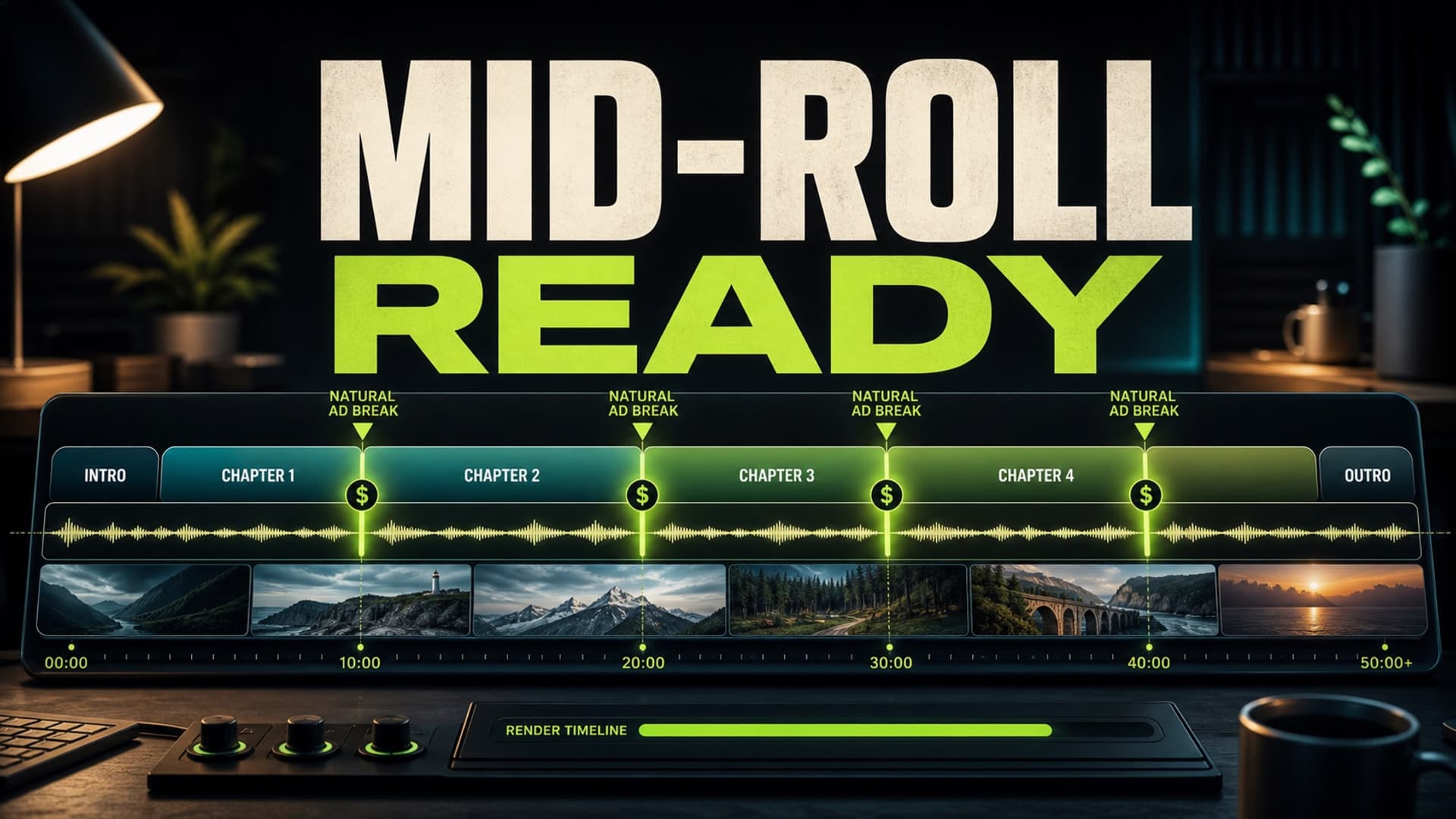
Mid-roll ads are one of the reasons long-form YouTube can become a real business instead of a content treadmill. A 35-minute documentary, explainer, story episode, or narrated sleep video gives you more room to earn from the same viewer session than a short, single-ad video.
But there is a catch: mid-roll revenue only works if the video structure can carry it.
If you write a long-form faceless video as one flat block of narration, every ad break feels like an interruption. Viewers drop, retention weakens, and the video becomes harder to monetize well over time. The better approach is to design natural pauses into the episode before you write the full script.
That does not mean stuffing ad breaks into the timeline. It means building a video that has chapters, turns, resets, and emotional breath. Those same structural moments make the video easier to watch and easier to monetize.
Why Mid-Roll Structure Matters
YouTube lets creators place mid-roll ads on eligible videos that are at least 8 minutes long. You can use automatic ad breaks, manual ad breaks, or a mix of both, depending on your workflow and channel settings.
For beginner faceless creators, the mistake is thinking about ad breaks after the edit is finished. By then, the pacing is already locked. You are trying to insert monetization into a script that was never built for it.
A stronger workflow starts earlier. When you plan the episode, ask: where would the viewer naturally accept a pause?
Good mid-roll moments usually happen after a promise has been partially paid off, before a new section begins, or after a clear story turn. Bad mid-roll moments happen in the middle of a sentence, in the middle of a reveal, or right after the viewer starts to feel confused.
The goal is not to hide ads. The goal is to avoid breaking the viewer's mental flow.
Start With the Episode Shape
Before writing the full script, map the video as a sequence of sections. For a long-form faceless video, those sections might look like this:
- Cold open or central question
- Context the viewer needs
- First major example or chapter
- Deeper explanation
- Tension, problem, or surprising turn
- Second major example or chapter
- Synthesis and takeaway
- Closing loop
This structure works for documentaries, mysteries, finance explainers, history videos, science breakdowns, and AI story channels. The labels change, but the principle stays the same: each section should have a job.
Once the section jobs are clear, mid-roll planning becomes less random. You are no longer asking where to interrupt the video. You are asking which transitions can support a short pause without damaging the experience.
Build Natural Breakpoints Into the Script
A natural breakpoint is a moment where the viewer feels one thought has ended and another is about to begin.
You can create that feeling with a simple transition line:
"But that was only the first problem."
"To understand why this mattered, we need to go back."
"The strange part is what happened next."
"This is where the story changes."
These lines are useful because they do two things at once. They close the previous section and open a new loop. If an ad appears near that moment, the viewer still knows what they are returning to.
For faceless channels, this is especially important because the viewer often depends on narration for orientation. There is no on-camera host to recover the rhythm after a clumsy interruption. The script has to do that work.
Avoid the Flat Timeline Problem
Many AI-assisted videos have a flat timeline: one idea after another, similar sentence length, similar visuals, similar pacing, no real section contrast. Even if the information is useful, the viewer starts to feel the sameness.
That flatness hurts mid-roll performance because there are no obvious places to pause. Every ad break feels equally arbitrary.
To avoid this, vary the density of the episode. Put heavier explanation next to lighter recap. Follow abstract points with concrete examples. Use section endings to summarize what changed. Give the viewer moments where they can breathe.
This is not only a monetization tactic. It is a retention tactic. Long-form viewers are more patient than casual scrollers, but they still need rhythm.
Do Not Over-Optimize for Ad Count
A common beginner question is: how many mid-roll ads should I place?
The better question is: how many natural ad opportunities does this video actually have?
A 12-minute explainer might only have one or two clean breaks. A 45-minute documentary may have several. A 2-hour narrated sleep history video needs a gentler approach because aggressive interruptions can damage the entire viewing promise.
If the format is calm, slow, or sleep-adjacent, protect the experience first. If the format is analytical or documentary-style, you can usually use more section breaks, as long as each break sits between ideas instead of inside them.
The viewer does not care that your production spreadsheet says the video needs another monetization point. They care whether the video still feels worth watching.
Plan Breaks Before Visuals and Voiceover
Mid-roll structure should be decided before voiceover, visuals, and final rendering. Once the narration is recorded and the scenes are assembled, changes become expensive.
A practical planning pass looks like this:
- Write the episode outline.
- Mark section transitions.
- Draft the script with clear closing and opening lines.
- Estimate likely ad break zones.
- Record voiceover with small natural pauses around those zones.
- Add visuals that reinforce the section change.
- Review the full render before publishing.
This keeps the production process cleaner. Instead of discovering pacing problems at the end, you are designing the monetization structure into the creative format from the start.
Match the Break Style to the Niche
Different faceless niches need different mid-roll behavior.
Documentary channels can use chapter turns: a new location, person, event, conflict, or theory. Explainer channels can use concept transitions: problem, cause, example, implication, solution. Story channels can use scene changes or cliffhanger resets. Sleep channels should be much more cautious, using fewer, softer breaks that do not break the calm promise of the video.
This is where long-form creators need taste. Automation can help produce more consistently, but the format still needs editorial judgment. If the ad structure fights the niche promise, the audience will feel it.
How AutoTube.pro Fits Into This Workflow
AutoTube.pro is useful when you want the mid-roll plan to stay connected to the actual production pipeline instead of living in a separate document.
A strong long-form workflow needs the script, voiceover, media plan, render, and thumbnail to follow the same structure. If the script has clear sections but the visuals are generated randomly, the episode still feels messy. If the voiceover ignores the intended pauses, the ad zones feel abrupt. If the render process is manual and fragile, testing different versions becomes painful.
With AutoTube.pro, a faceless creator can move from script to voiceover to media generation to rendering inside one long-form production system. That matters for mid-roll planning because the monetization structure is not an isolated publishing setting. It is part of the episode's shape.
The built-in Canvas-style thumbnail editor also helps keep the packaging aligned with the video promise. If the thumbnail sells a serious documentary, the video structure should feel serious and intentional. If the thumbnail sells a calm sleep history episode, the pacing and ad approach should respect that promise.
FAQ
Do mid-roll ads hurt retention?
They can, but they do not have to. Mid-roll ads are most damaging when they appear at awkward moments, such as during a sentence, reveal, or unresolved explanation. Placing them near natural section breaks makes the interruption easier for viewers to accept.
How long should a video be for mid-roll ads?
YouTube's mid-roll eligibility starts at 8 minutes, but that does not mean every 8-minute video needs several breaks. The right length depends on the niche, pacing, and viewer intent. Long-form videos usually work best when the topic genuinely needs the runtime.
Is AI-generated content monetizable on YouTube?
AI-assisted content can be monetizable when it adds original value and follows YouTube's policies. The risk is low-effort, repetitive, or reused-style content that does not provide enough original commentary, structure, or creative input. Treat AI as a production tool, not as a substitute for editorial judgment.
Does YouTube penalize AI voiceover?
YouTube does not automatically penalize a video just because it uses AI voiceover. The bigger issues are quality, originality, viewer satisfaction, and whether the content misleads people. A clear, natural, well-paced voiceover is much stronger than a rushed robotic narration.
Should sleep channels use mid-roll ads?
They can, but they should be careful. A sleep-focused viewer is often choosing the video for calm continuity, so aggressive ad placement can damage the core experience. Fewer, softer breaks are usually safer than maximizing ad opportunities.
Final Thought
Mid-roll revenue is not just a publishing setting. It is a structural choice.
If you want long-form faceless videos to earn better without feeling chopped up, plan the episode around natural transitions before production starts. Build the breaks into the outline, support them in the script, respect them in the voiceover, and check them in the final render.
For creators who want that whole workflow in one place, AutoTube.pro can help turn long-form video production into a repeatable system instead of a pile of disconnected tools.