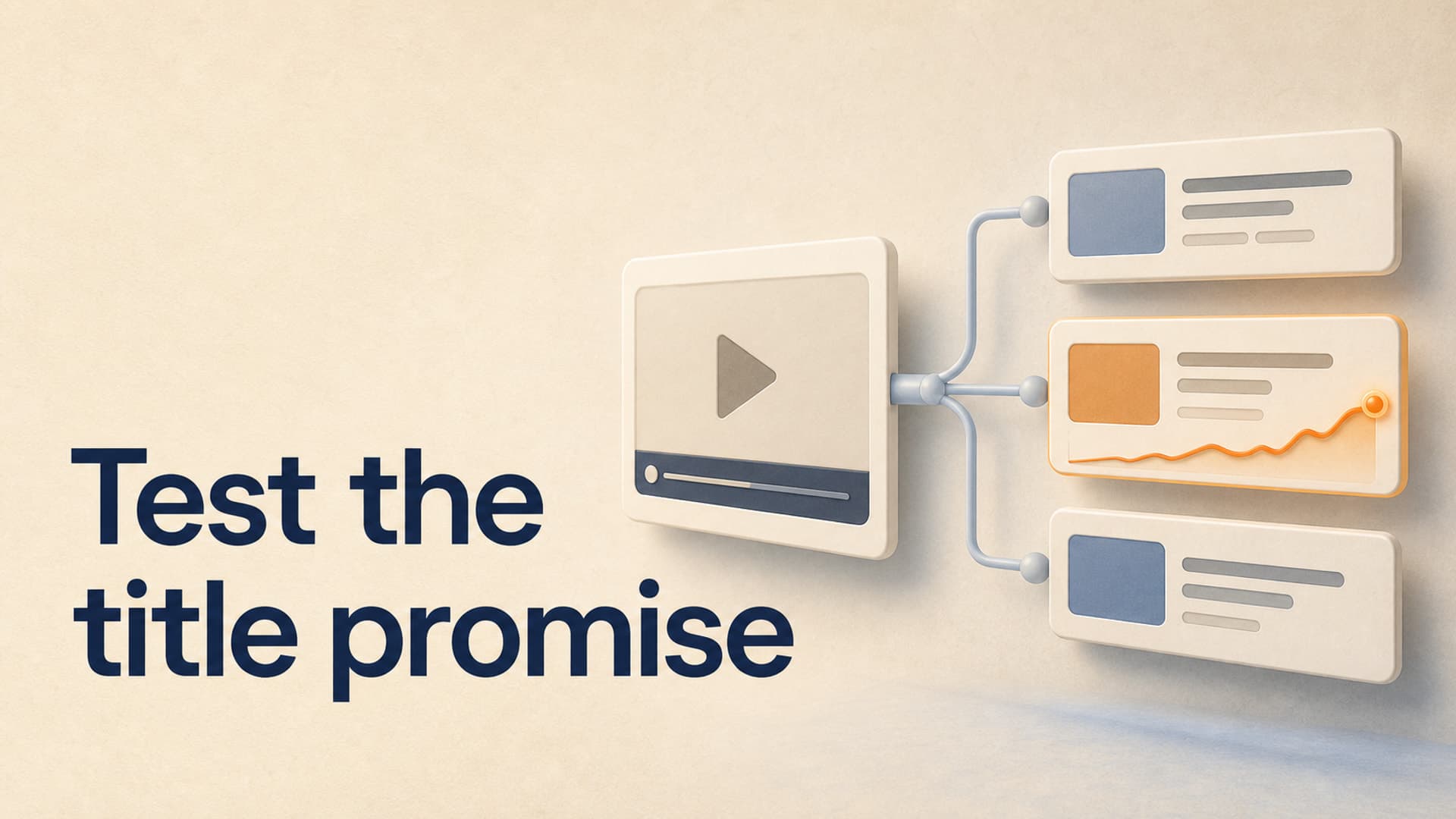
A title test is not a contest between three ways of saying the same sentence.
That is the mistake. A creator writes one title, swaps two adjectives, and waits for YouTube to reveal a winner. Even when the test finishes, the result teaches almost nothing. You did not test three ideas. You tested punctuation.
YouTube now lets eligible creators compare up to three titles, thumbnails, or title-and-thumbnail combinations on one video. The native experiment runs the variants concurrently and evaluates them by watch-time share rather than click-through rate alone. That makes title testing especially useful for long-form videos, where a cheap click can produce a weak session and a precise promise can attract fewer but better-matched viewers.
The real opportunity is not finding one lucky headline. It is learning which promise your audience wants from this kind of video.
The Packaging Question Comes Before the Wording
Every strong long-form title answers a quiet viewer question: "What will I get for giving this video my time?"
A 45-minute history documentary might offer discovery, explanation, suspense, or a surprising correction to something the viewer believes. Those are different promises. The title should select one.
Before drafting variants, finish this sentence three times:
Watch this video because you will...
If all three endings mean the same thing, the titles are not different enough to produce a useful lesson.
A practical title test can compare these three promise families:
- The answer promise: The viewer will understand why something happened.
- The discovery promise: The viewer will encounter a hidden person, place, event, or detail.
- The stakes promise: The viewer will see how one decision changed the outcome.
These are not universal formulas. They are controlled differences. You can replace them with other families that fit your niche - a transformation, a mystery, a myth correction, a practical result, or a character conflict. What matters is that each variant gives the viewer a genuinely different reason to start.
A Worked Three-Title Test
Imagine a 38-minute documentary about the Franklin expedition. The script covers the ships becoming trapped, the command decisions, the abandoned camps, and the evidence later found by search parties.
Three titles could be:
- Answer: Why the Franklin Expedition Never Came Home
- Discovery: What Search Parties Found After Franklin Vanished
- Stakes: The Decision That Doomed the Franklin Expedition
All three accurately represent the same finished video. But they frame the value differently.
The answer title promises a complete explanation. The discovery title foregrounds evidence and invites curiosity. The stakes title turns the story around a consequential choice.
That difference is large enough to teach you something. It is also honest enough that the opening can satisfy any of the three promises. If the video spends only 40 seconds on the supposed "decision," the stakes version is not a daring title. It is a mismatch.
Use a quick pre-test check before uploading:
| Check | Answer title | Discovery title | Stakes title |
|---|---|---|---|
| Supported by the script | Yes | Yes | Yes |
| Paid off in the first 90 seconds | Yes | Yes | Yes |
| Clearly different viewer motive | Explanation | Evidence | Consequence |
| Understandable without channel context | Yes | Yes | Yes |
| Works with the same thumbnail | Yes | Yes | Yes |
That last row matters. If one title requires a completely different image to make sense, you may be testing a package rather than a title. That can still be valuable, but it answers a different question.
Decide Whether You Are Testing the Title or the Package
YouTube offers title-only, thumbnail-only, and combined title-and-thumbnail tests. Choose the mode based on what you want to learn.
Use a title-only test when the thumbnail already communicates the subject clearly and you want to compare viewer motives. Keep the thumbnail unchanged so the interpretation stays clean.
Use a combined test when each promise needs its own visual evidence. A title about a decision might pair with a map and route marker, while a title about discoveries might pair with an artifact. The result tells you which complete package generated more watch time. It does not tell you whether the words or the image caused the difference.
For a small channel, clean learning is often more valuable than squeezing every variable into one experiment. Test the title first on an older video with steady impressions. YouTube itself recommends starting with older videos to reduce the impact on overall channel views. The platform says a test can take a few days or up to two weeks, depending partly on impressions and how recently the video was published.
Do not manually edit the title or thumbnail during the experiment. YouTube says that stops the test and requires a restart.
Read the Result Without Inventing a Story
A native test can end with a winner, performed same, or inconclusive result. Each outcome deserves a different action.
Winner
A winner means one option clearly outperformed the others by watch-time share with enough statistical confidence.
Record the winning promise, not just the exact title. "Decision-led stakes beat explanation on expedition stories" is reusable. "The word doomed worked" is speculation unless you test that word separately.
Then repeat the promise family on a comparable topic, not every upload on the channel. A title pattern that works for a disaster documentary may fail on a calm science explainer.
Performed Same
This is not a failed test. It means the options performed about the same.
Choose the clearest title, then ask whether the three promises were truly distinct. If they were, your audience may care more about the subject or thumbnail than the framing. If they were nearly synonymous, improve the next test rather than squeezing meaning from tiny percentage differences.
Inconclusive
An inconclusive result means the experiment did not find a strong statistical difference. Low impressions or weakly differentiated variants can contribute.
Do not crown the numerically highest option by eye. Keep the first or clearest title and put the lesson in your backlog: use a higher-traffic older video, create wider promise separation, or wait until you can accumulate enough impressions.
The discipline here is refusing to convert noise into a channel rule.
Build a Promise Ledger, Not a Swipe File
A swipe file collects phrases. A promise ledger collects evidence.
For each completed test, log:
- Video topic and format
- The three promise families
- Exact title variants
- Test mode: title-only or combined
- Result: winner, performed same, or inconclusive
- Winning watch-time framing, when available
- One sentence about what you will test next
After five to eight useful tests, look for patterns within comparable videos. You may find that mystery framing works for biographies, explanation wins for engineering failures, and stakes framing works for political turning points.
That is more valuable than a list of "power words." It connects packaging to the viewer's reason for watching.
Avoid changing your production format at the same time. If one documentary is 18 minutes with fast visual changes and the next is 75 minutes with slow narration, their title results do not form a clean comparison. Treat title testing as channel research, not a universal law.
Where AutoTube.pro Helps
Title experiments become easier when video production is consistent enough that packaging is the main variable.
AutoTube.pro stores reusable channel presets for script style, voice, visuals, and rendering, so comparable uploads can keep the same production baseline. Its research-backed long-form script workflow also makes it easier to verify that each proposed title promise is genuinely supported by the outline and paid off in the finished narration.
It does not replace YouTube Studio's experiment. It helps create a repeatable production environment around it - particularly useful when you operate several faceless channels and need each test logged against a stable format.
Make the Next Upload an Experiment
Take one older long-form video with steady impressions. Write an answer title, a discovery title, and a stakes title. Confirm that the same video honestly fulfills all three, then run a title-only test and leave it alone until YouTube finishes.
Whatever the result, write down the promise you tested and the next decision it changes. One experiment gives you a title. A disciplined sequence of experiments gives you a packaging strategy.