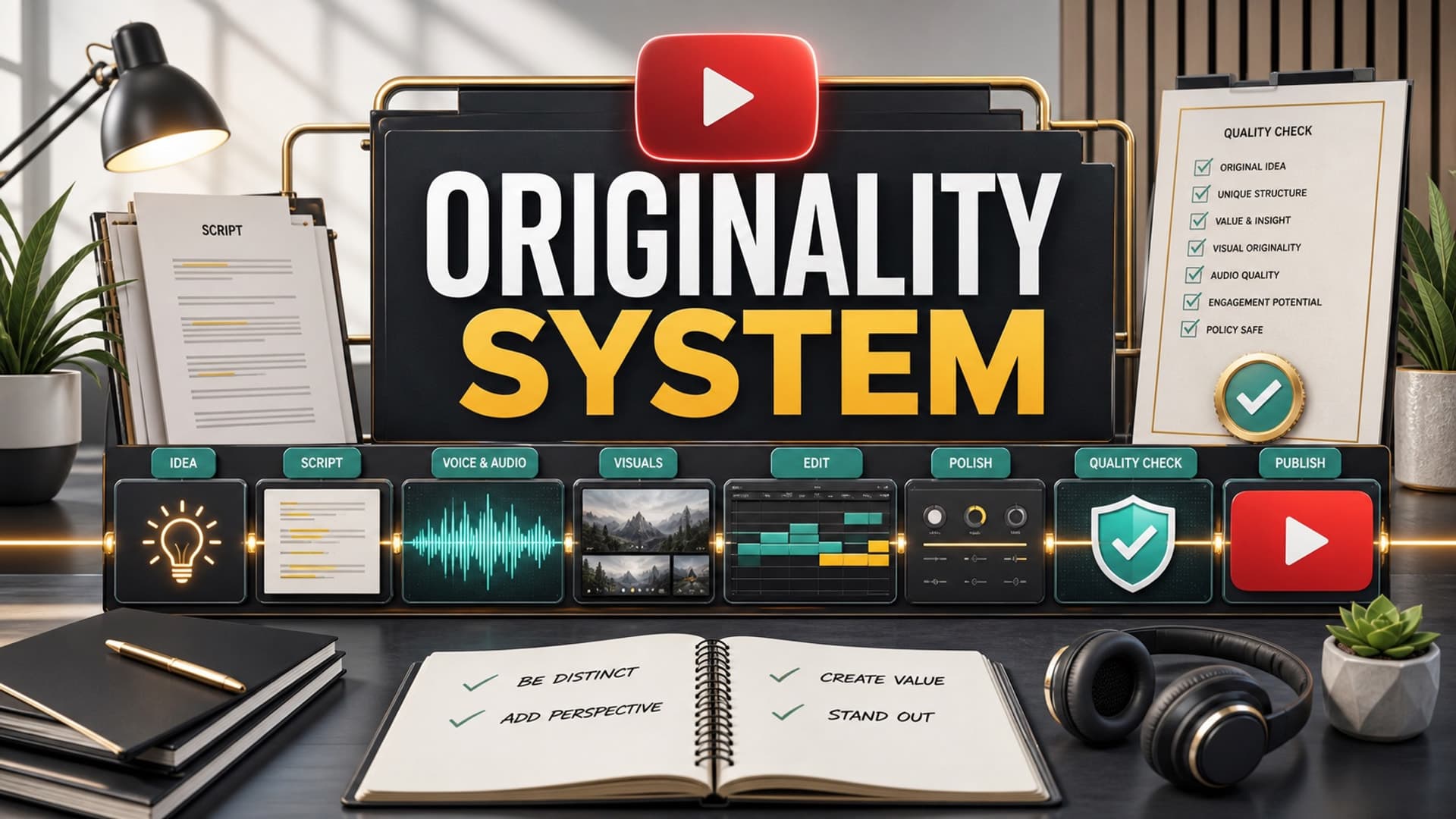
Faceless AI video has a strange tension built into it.
The same tools that make production easier can also make every upload feel more templated. A creator can generate a script, voiceover, visuals, music bed, and edit plan faster than ever, but speed alone does not make a channel more valuable. In many cases, it makes the weaknesses easier to repeat.
That matters more now because YouTube has been clearer about the difference between original, authentic work and content that looks mass-produced. YouTube's channel monetization policies say monetized content should be original and authentic, and its inauthentic content guidance focuses on repetitive or mass-produced videos with little meaningful variation. For faceless AI creators, the lesson is not "avoid AI." The lesson is to stop treating AI as a template machine.
If you want a long-form faceless channel to survive review, earn trust, and build a real audience, you need an originality system before you need more output.
The Problem Is Not AI Voiceover or AI Visuals
A lot of creators ask the wrong question: "Will YouTube monetize AI videos?"
The better question is: "Can a viewer tell this video has a specific idea, structure, and point of view?"
AI voiceover is not automatically low quality. AI visuals are not automatically a problem. A faceless format is not automatically less original than a talking-head format. The issue is sameness: the same script shape, the same generic claims, the same stock pacing, the same visual rhythm, and the same recycled topic promise repeated across uploads.
Long-form channels are especially exposed because weak structure becomes obvious over 20, 40, or 90 minutes. A short mediocre clip can hide behind momentum. A long video has to sustain attention with substance. If the episode is only a stack of generated paragraphs and loosely related visuals, viewers feel the emptiness quickly.
That emptiness is what an originality system is meant to prevent.
Start With a Non-Generic Episode Promise
Originality starts before the script.
A weak episode promise sounds like this: "The dark history of ancient Rome." It is broad, familiar, and easy for any tool to imitate. A stronger promise adds a specific angle: "How Roman apartment fires shaped the daily life of ordinary renters." That second idea gives the script a spine. It implies scenes, stakes, examples, and a point of view.
For faceless creators, every episode should answer three questions before production starts:
- What is the specific viewer curiosity?
- What will this video explain, reveal, or reframe?
- Why should this episode exist instead of a generic version of the topic?
This does not mean every video needs a shocking premise. Sleep history, calm documentaries, explainers, and story channels can all be subtle. But the episode still needs a clear reason to exist.
A good test is whether you can describe the video in one sentence without using vague words like "interesting," "amazing," "unknown," or "crazy." If you need those words to make the idea sound compelling, the premise probably is not specific enough yet.
Add Original Value at Each Production Stage
The safest faceless AI workflow adds value in layers. Do not rely on one stage to carry the whole video.
At the research stage, collect details that a generic prompt would miss: dates, locations, terminology, counterexamples, or expert disagreements. At the outline stage, decide what the viewer should understand by the end. At the script stage, add transitions, explanations, and judgment. At the voiceover stage, choose pacing that fits the format instead of accepting the default read. At the visual stage, avoid random image matching and build a consistent visual language.
The goal is not to prove that every pixel was handmade. The goal is to make the finished video feel intentionally produced.
For long-form faceless channels, that usually means adding original value in at least four places:
- A narrower topic angle than the obvious version.
- A custom structure that matches the episode's purpose.
- Script-level commentary, interpretation, or synthesis.
- Visual and audio choices that support the story instead of merely filling time.
When all four are present, AI becomes a production accelerator. When they are absent, AI becomes a sameness multiplier.
Build a Repetition Check Before You Render
Many creators only review a video for factual mistakes or obvious visual errors. That is not enough.
Add a repetition check before rendering. Look across your last 5-10 uploads and ask whether the new video uses the same opening move, the same middle structure, the same emotional arc, and the same ending. Repetition is not always bad - channels need formats - but the substance must vary.
Useful questions include:
- Does this video make a different promise from recent uploads?
- Does the script contain examples specific to this episode?
- Are the visual scenes designed around the topic, or are they interchangeable?
- Would a viewer learn something meaningfully different from this upload?
- Does the thumbnail and title accurately represent the actual video?
This last point matters. YouTube reviewers may look at metadata such as titles, thumbnails, and descriptions when assessing a channel. If your packaging promises depth but the video delivers generic narration, the channel starts to look weaker as a whole.
Keep Templates for Process, Not Thought
Templates are useful. A repeatable production process is one of the best advantages a small creator can build. The danger is using templates for the thinking itself.
Use templates for checklists, file naming, render settings, thumbnail review, and production stages. Be more careful with templates for hooks, story beats, and conclusions. If every video opens with the same rhetorical question and resolves with the same vague lesson, the format becomes visible in the worst way.
A better approach is to keep a stable production workflow while changing the intellectual shape of each episode. A documentary might need a mystery structure. A sleep history video might need a calm chronological drift. An explainer might need a problem-solution structure. An AI story might need stronger character logic.
The workflow can stay consistent. The thinking should not feel copied.
How AutoTube.pro Fits Into This Workflow
Once you have a clear originality system, AutoTube.pro can help turn it into a repeatable long-form production pipeline.
The platform is built for faceless creators who want to move from idea to finished video without stitching together half a dozen disconnected tools. You can use it to generate structured scripts, create AI voiceover, build visual scenes, render long-form videos, and create thumbnails in one workflow.
The important part is to feed the system with real direction. A strong topic brief, episode promise, source notes, pacing requirements, and visual style guidance will usually produce a more distinct result than a loose prompt. That is where the originality system and the software work together: the creator defines the judgment, and the platform handles much of the production load.
For creators making documentaries, explainers, stories, or narrated sleep videos, this matters because long-form production has a lot of places to break. Scripts get too generic. Voiceovers drift. Visuals lose consistency. Renders become fragile. Thumbnails get treated as an afterthought. Keeping script -> voiceover -> media -> render -> thumbnail inside one platform makes it easier to maintain the same episode promise from start to finish.
FAQ
Does YouTube Penalize AI Voiceover?
No, AI voiceover is not automatically penalized. The bigger issue is whether the finished content is original, useful, and not mass-produced with minimal variation. A strong script, clear structure, and thoughtful production matter more than whether the narration came from a human or synthetic voice.
Is AI-Generated Content Monetizable on YouTube?
AI-generated content can be monetizable when it follows YouTube's policies and adds real value for viewers. Problems usually appear when channels publish repetitive, templated, misleading, or reused content without meaningful commentary, education, or creative input. Treat AI as part of the production process, not as a substitute for editorial judgment.
How Long Should Faceless AI Videos Be for Better RPM?
There is no universal best length. Longer videos can create more monetization opportunities, but only if viewers stay engaged and the topic supports the runtime. For many faceless creators, the better goal is to choose a length the idea can honestly sustain, then improve retention and consistency.
How Can I Make AI Videos Feel Less Generic?
Start with a narrower episode promise, add research details, customize the outline, and review the script for repeated phrasing or empty claims. Then make sure the visuals and voiceover support the actual story. Generic videos usually come from generic inputs and no review stage.
Do I Need to Show My Face to Prove Originality?
No. A faceless channel can still be original if the scripting, research, commentary, structure, editing, and presentation create meaningful value. Showing your face may help some formats, but it is not the only way to demonstrate authorship.
The Real Advantage Is Better Judgment
Faceless AI creators do not win by producing the most videos with the least thought. That path leads to sameness, weak retention, and monetization anxiety.
The stronger path is to build a channel where every episode has a specific promise, a distinct structure, and enough original value that viewers can feel the difference. Once that system is in place, production tools become genuinely useful because they help you ship more of your best thinking.
If you want to build long-form faceless videos around a repeatable script, voiceover, media, render, and thumbnail workflow, AutoTube.pro is designed for exactly that kind of production system.