Most faceless channels do not fail because the first video is bad. They fail because the niche was never strong enough to support a repeatable channel.
A beginner can usually force one decent video out of almost any idea. One mystery recap, one history topic, one AI story, one explainer, one finance list, one product comparison. The problem shows up around upload five, ten, or twenty, when every new idea starts feeling like a worse version of the first one.
That is the niche problem hiding underneath many production problems.
If the niche is too narrow, you run out of fresh topics. If it is too broad, viewers do not know what they are subscribing to. If it depends on whatever is trending this week, the channel becomes stressful to operate. If the visuals are too hard, every upload becomes a custom art project. If the script angle is too shallow, the videos feel interchangeable even when the titles are different.
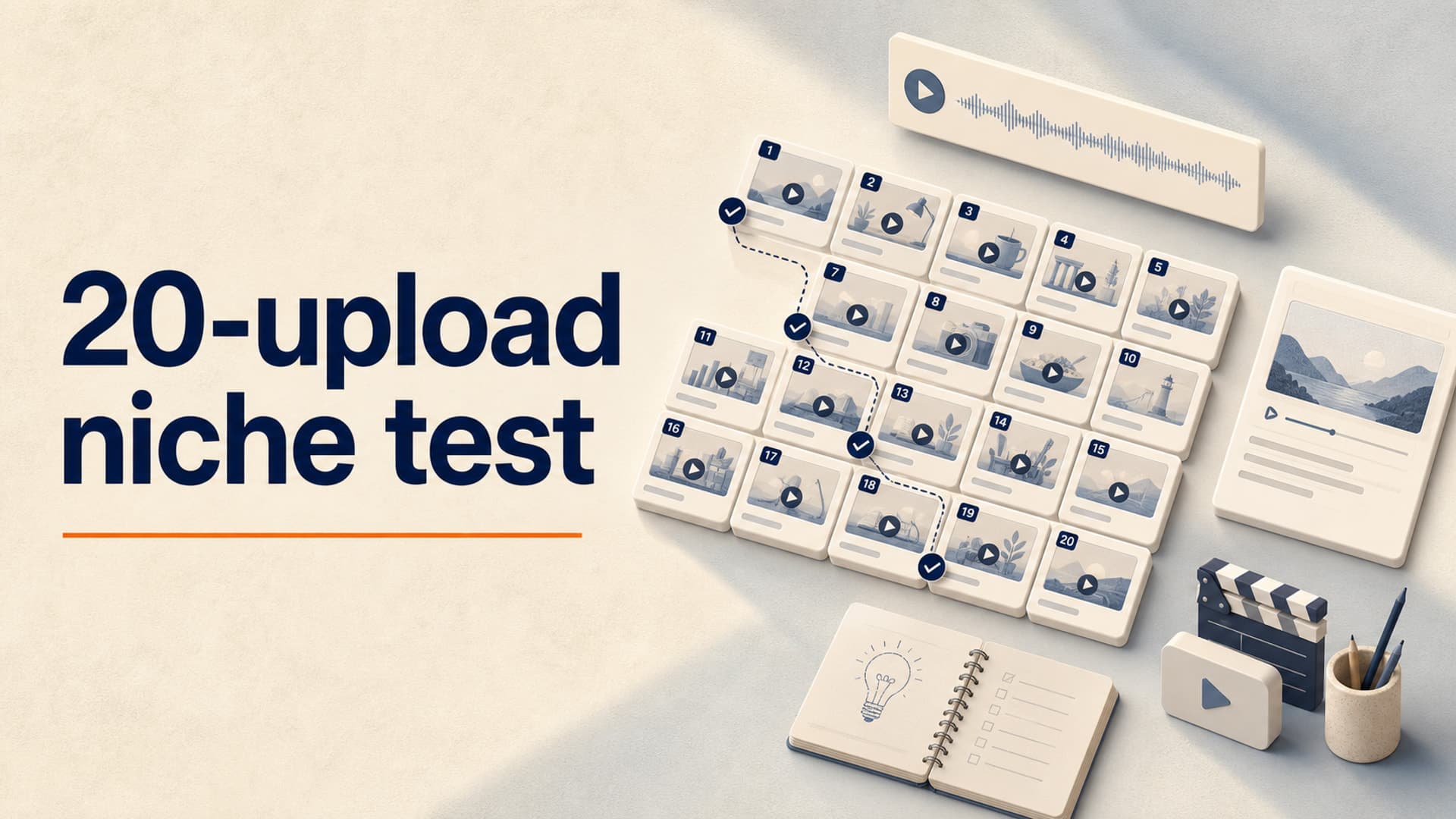
Before committing to a faceless YouTube niche, test whether it can survive 20 long-form uploads. Not because 20 is a magic number, but because it is long enough to expose weak formats, repetitive scripts, visual fatigue, and topic scarcity.
The 20-Upload Test
A niche is not just a topic category. It is a promise you can repeat.
"History" is not a niche. "Calm 90-minute stories about forgotten medieval power struggles" is closer to one. "AI explainers" is not a niche. "Slow, practical explainers of AI tools for solo business owners" has a clearer viewer and format. "Scary stories" is too loose. "Rainy-night fictional mysteries told in a quiet documentary voice" is more usable.
The 20-upload test asks one question: could this channel publish 20 videos without changing the viewer promise?
Open a blank document and try to list 20 long-form video ideas under the same promise. Do not count ideas that only work because they are the same story with a different noun. Do not count ideas that would require a completely different audience. Do not count ideas that depend on a one-time news cycle.
A healthy list has range inside a recognizable container.
For example, a weak niche list looks like this:
- The history of Rome
- The history of Greece
- The history of Egypt
- The history of China
- The history of Japan
Those are topics, but they do not yet prove a channel. Each one could become a totally different style of video.
A stronger list has repeatable episode logic:
- The forgotten Roman emperor who bought the throne
- The Greek general who won by refusing battle
- The Egyptian queen erased by her successors
- The Chinese siege that became a waiting game
- The Japanese clan feud that turned into a century-long myth
Now the channel has a pattern: overlooked historical conflict, specific human stakes, and a narrative promise. The viewer knows what kind of satisfaction they are coming back for.
Specific Entry, Broad Category
A useful niche usually has a specific entry and a broad category.
The specific entry is what makes each video clickable. It might be one ruler, one failed expedition, one unsolved engineering problem, one strange business collapse, one myth, one invention, one legal case, or one psychological trap.
The broad category is what keeps the channel alive. It gives you enough room for 50, 100, or 200 uploads without becoming random.
This balance matters more now because AI makes surface-level production easier. A creator can generate a script, voiceover, and visuals quickly, but that also means viewers see more channels with similar pacing, similar topics, and similar generic framing. The niche has to create the difference before the tools touch the video.
A simple test is to write your channel promise in this format:
"This channel makes [format] about [specific subject type] for viewers who want [emotional or practical payoff]."
Examples:
- This channel makes quiet documentary stories about forgotten explorers for viewers who want calm, intelligent sleep content.
- This channel makes long-form explainers about failed startups for viewers who want business lessons without hype.
- This channel makes cinematic mythology retellings about lesser-known legends for viewers who want immersive story worlds.
- This channel makes practical AI workflow breakdowns for creators who want to save time without becoming tool collectors.
If you cannot finish that sentence without sounding vague, the niche is probably not ready.
Four Filters Before You Commit
Use these filters before you spend a month producing videos.
1. Topic Depth
A long-form niche needs depth, not just popularity.
Ask whether each video can support at least three layers: what happened, why it mattered, and why the viewer should keep listening. A 45-minute video about a historical event cannot survive on a timeline alone. It needs tension, characters, turning points, consequences, and unanswered questions.
For explainer channels, depth might come from examples, mistakes, tradeoffs, and step-by-step reasoning. For story channels, it comes from structure, stakes, atmosphere, and payoff. For documentary channels, it comes from sources, context, and interpretation.
If most ideas collapse into a 600-word summary, the niche may be better suited to short social clips than long-form YouTube. For a long-form faceless channel, you want topics that naturally expand to 15, 30, 60, or even 90 minutes without padding.
2. Production Repeatability
A niche can be interesting and still be painful to produce.
Before committing, choose five sample titles and sketch what each video would need:
- Research sources
- Script structure
- Narration style
- Visual style
- Music or ambience
- Thumbnail concept
- Expected video length
- Review risks
Look for repeated assets and decisions. Can the same narrator style work across the whole channel? Can the same visual language carry multiple episodes? Can the same script structure be reused without making the videos feel cloned?
The best faceless niches create reusable production decisions. The worst ones demand a new visual universe every time.
A practical benchmark: if the first video takes 100 units of effort, the fifth should take closer to 60-70 because the format is becoming clearer. If every video still feels like starting from zero, the niche may be too custom for consistent publishing.
3. Originality Surface
YouTube's monetization guidance is clear that reused or low-effort repackaging is risky. YouTube says reused content needs meaningful difference, such as original commentary, substantive changes, or added educational or entertainment value. Its AI disclosure guidance also requires creators to disclose realistic altered or synthetic content when relevant.
That does not mean faceless or AI-assisted channels cannot work. It means the channel needs an originality surface: the part of the video where your judgment is visible.
That surface can be:
- A specific narrative angle
- Original commentary
- Better research synthesis
- A distinctive pacing style
- A recurring framework
- A clear editorial point of view
- A calmer, more useful version of a noisy topic
If the niche can only survive by rephrasing other people's videos, it is weak. If it lets you add structure, interpretation, selection, and taste, it has a better foundation.
4. Viewer Return Reason
Many creators test niches by asking, "Can this video get views?" That is useful, but incomplete.
The better question is: "Why would someone come back for the next one?"
A viewer might return for comfort, curiosity, expertise, story world, practical utility, or a trusted format. The return reason should be strong enough that the channel does not rely only on one viral topic.
For a sleep history channel, the return reason might be calm narration plus strange true stories. For a business documentary channel, it might be clear lessons from failures. For an AI explainer channel, it might be saving viewers from confusing tool noise.
If each video attracts a different audience, the channel may grow slowly even when individual uploads perform well.
A Simple Scoring Sheet
Score a niche from 1 to 5 on each line:
- Can I list 20 strong video ideas without repeating myself?
- Can at least 10 of those ideas support long-form treatment?
- Is the viewer promise clear in one sentence?
- Can I reuse the same voice, pacing, and visual style?
- Does the niche give me room for original commentary or structure?
- Would the same viewer plausibly watch five videos from this channel?
- Can I make the fifth video faster than the first?
A score of 28 or higher is worth testing. A score under 22 needs tightening. The most dangerous score is a high topic-depth score with a low repeatability score, because that niche will produce one impressive video and then punish you for scaling it.
This is the "documentary trap": every topic is fascinating, but every episode requires a different research process, visual system, script shape, and thumbnail strategy. It can work, but only if you are prepared to operate like a real editorial team.
What to Produce First
Do not start with the biggest possible video.
Start with a format pilot: one video that proves the channel promise without exhausting the entire niche. It should be specific enough to attract the right viewer and repeatable enough that you can immediately imagine the next four uploads.
For a beginner-to-intermediate creator, a good pilot often sits in the 12-30 minute range. That is long enough to test pacing, voiceover, visuals, and retention, but not so long that one failed experiment consumes the whole month.
After the pilot, do not ask only whether the video performed. Ask whether the production system improved:
- Did the script structure become clearer?
- Did the voice direction become more obvious?
- Did the visual style reveal itself?
- Did the next topics become easier to choose?
- Did comments or retention hint at what viewers came for?
A good niche gets easier to understand after the first upload. A bad niche gets more confusing.
Common False Positives
Some niches look strong during research and weak during production.
A high-search topic can still be a poor channel if every creator is already making the same video. A visually exciting topic can still fail if the visuals take too long to produce consistently. A monetizable category can still be bad for beginners if it requires expertise they do not have yet. A calm sleep-friendly niche can still be thin if the stories do not contain enough narrative movement.
Watch for these warning signs:
- Every title starts with the same phrase.
- The channel promise only makes sense because AI can generate the assets.
- The viewer would not know why to subscribe after watching one video.
- The topic list depends on trend-chasing.
- The niche requires a new format for every upload.
- The first five ideas are strong and the next fifteen are filler.
The goal is not to find the biggest niche. The goal is to find a niche where your production system and viewer promise reinforce each other.
FAQ
How many videos should I test before judging a faceless niche?
Judge the niche after at least 5-10 serious uploads, but test the idea before publishing by planning 20. The pre-test reveals whether the channel has enough range. The published test reveals whether viewers respond to the promise.
Can AI-generated faceless channels be monetized?
They can be, but the content still needs to meet YouTube's monetization standards. The safer path is to add clear original value through research, commentary, structure, storytelling, or education instead of mass-producing generic videos.
Does YouTube penalize AI voiceover?
AI voiceover itself is not the issue. Problems usually come from misleading synthetic content, reused material, repetitive uploads, or videos with too little original value. Creators should follow YouTube's disclosure rules when content is realistic and synthetically generated or altered.
What makes a niche good for long-form faceless videos?
A strong long-form niche has repeatable structure, enough topic depth, a clear viewer return reason, and production decisions you can reuse. It should make the tenth video easier to produce than the first, not harder.
Should I choose a niche based on RPM?
RPM matters, but it should not be the first filter. A high-RPM niche with weak originality, shallow topics, or impossible production demands can burn out quickly. Start with viewer promise and repeatability, then consider monetization fit.
A Faster Way to Test and Operate a Niche
Once the niche passes the 20-upload test, the next challenge is turning it into a repeatable production system. That is where AutoTube.pro can help.
For this kind of niche work, the most relevant feature is channel presets. You can store the script style, voice, visual direction, media preferences, render settings, and description defaults for each channel, then reuse those decisions across future videos. That matters because a niche is not only a list of topics. It is a set of repeatable creative choices.
AutoTube.pro also supports research-backed script generation, which is useful when the niche depends on documentary, explainer, or story structure rather than a single loose prompt. If your channel promise is built around thoughtful long-form videos, stronger research and outlines make the production system more durable.
The point is not to automate your taste away. The point is to stop rebuilding the same production decisions from scratch every time you test a new upload.
If you already have a niche that can survive 20 real ideas, AutoTube.pro gives you a cleaner way to turn that promise into consistent long-form videos.